Sustainable Gift Boxes UK: What “Eco-Friendly” Actually Means for Christmas 2026
In the UK, printing “eco-friendly” on a gift box with nothing behind it can now trigger a Competition and Markets Authority investigation and a fine of up to 10% of global turnover under the DMCC Act. A genuinely sustainable claim needs a specific, checkable fact – a recycled-content percentage, a home-vs-industrial compostability distinction – covering every component, not just the outer box.
As an illustrative example: a small gifting brand printed “eco-friendly” on its Christmas boxes for two seasons, backed by little more than a recyclable outer box and an assumption that it held up. The foam insert inside wasn’t recyclable at all – which meant the claim, taken as a whole, wasn’t accurate. That single unbacked word is now the kind of thing that gets a UK brand into genuine legal trouble.
This guide covers what a sustainable gift box UK brands sell can actually claim honestly this Christmas, what the current rules require, and what it costs to get it right rather than just sound right.
Why “Eco-Friendly” Alone Isn’t Safe to Print Anymore
Real enforcement power now exists. Since the Digital Markets, Competition and Consumers Act (DMCC Act) came into force on 6 April 2025, the Competition and Markets Authority (CMA) can investigate a business, determine a consumer-law breach, and issue a fine – up to 10% of global annual turnover – without going to court first. On 22 January 2026, the CMA published new supply-chain guidance making clear that liability extends to anyone who repeats or relies on a misleading claim, not just whoever coined it – so a retailer stocking someone else’s mislabelled box carries risk too.
Is enforcement actually happening yet? So far, the CMA’s confirmed green-claims actions have targeted fashion retailers (ASOS, Boohoo, George at Asda), not packaging suppliers specifically. That doesn’t mean packaging is safe – it means the tools now exist and the CMA has shown it will use them, which is exactly why waiting for a packaging-specific case before cleaning up claims is the wrong bet.
It sits alongside a genuine shift in Europe too, though the details are more specific than “an EU directive is coming.” The much-discussed EU Green Claims Directive proposal was effectively paused by the European Commission in June 2025 and remains stalled. What is live and binding is a separate law – the Empowering Consumers for the Green Transition Directive – which member states must apply from 27 September 2026, and which bans generic, unsubstantiated “eco-friendly”-style claims outright. UK brands selling into EU markets are looking at that date directly.
Gift packaging carries extra risk because it’s one of the few formats where a brand is making an emotional, values-based sell to the customer. “This gift is thoughtful, and so is how we’ve packaged it” is a real selling point at Christmas – which is exactly why it’s tempting to reach for language that sounds good without checking whether it’s defensible.
What Genuinely Sustainable Gift Packaging Requires
A sustainable gift box that UK buyers can actually stand behind needs to satisfy a few concrete things, not just a general impression of being better for the planet.
Every component needs checking, not just the outer box. A recyclable claim printed on a beautiful kraft box means nothing if the ribbon, the tissue paper, or the foam insert inside can’t go through the same recycling stream. Claiming the box is recyclable while ignoring parts that aren’t is greenwashing by omission – an easy mistake to make, honestly, since most brands design the box and its internal components separately and never step back to check whether the finished, assembled product holds together as a single recyclable unit.
Do I need to state a percentage for a recycled content claim? Yes. Under CMA guidance, “made from recycled materials” without a number attached is treated the same way as “eco-friendly” – too vague to check, which means too vague to trust. State the actual percentage and, where a supplier can provide it, whether the content is pre- or post-consumer.
What’s the difference between home and industrial compostable, and does it matter for gift wrap? Yes, and it trips up gift packaging as much as food packaging. A wrap that’s only industrially compostable but marketed simply as “compostable” is misleading, because most customers composting a bit of gift wrap at home have no access to an industrial facility. State which one clearly.
Materials That Actually Hold Up to Scrutiny This Christmas
Skip the plastic – still not automatically sustainable. A box can be entirely plastic-free and still be built from virgin board with a solvent-based coating, and none of that does the planet any favours. “No plastic” gets treated like the full picture when it’s really one piece of it.
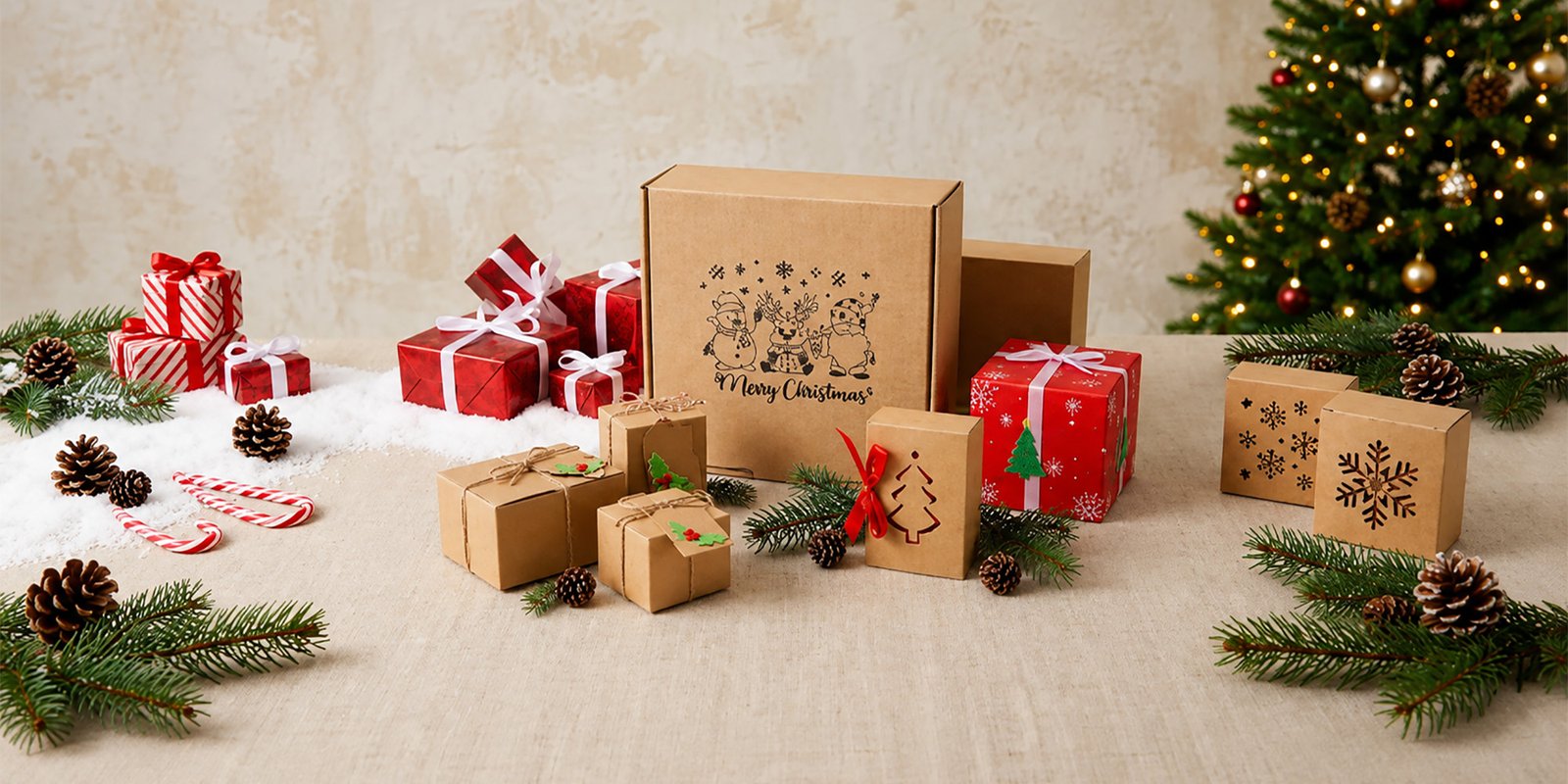
Kraft or recycled corrugated card is one of the more defensible choices when it’s genuinely sourced with a verifiable recycled-content percentage – not exotic and not dramatically more expensive than virgin board once total cost is compared properly (see the cost table below).
Paper-based void fill keeps everything in one recyclable stream. Swap that for plastic air pillows or glittered, foil-coated wrapping paper, and you’ve broken it.
Does glitter or foil make a box unrecyclable? Often, yes. Bonded glitter or metallic foil looks the part at Christmas, but once it’s fused to the board, most UK recycling streams can’t process it — the box that looked festive stops being recyclable the moment those finishes are added.
What This Means for a Small Brand Specifically
A small gifting or candle brand doesn’t need a sustainability department to get this right — it ,needs a genuine habit of checking claims against evidence before they go to print. Start by going through every claim currently sitting on your packaging, your website, and any Christmas marketing, and be honest about which ones would actually hold up if challenged. Cut the vague words – “eco-friendly,” “green” – and put something specific in their place: “80% recycled card” instead of “eco-friendly box.” One of those two claims you can prove on request. The other you can’t.
Then check that every recyclability claim matches what actually gets collected in the markets you sell into — don’t assume based on what the material usually is. And keep the paperwork (supplier certificates, recycled-content percentages, compostability results) as an ongoing record, not something scrambled together after a complaint lands.
What Counts as a Greenwashing Packaging Claim
Greenwashing claims aren’t limited to obviously exaggerated language. Some of the most common examples that catch brands out are ordinary-looking:
- A leaf icon or green colour scheme with nothing certifying it – a design choice leaning on the association rather than substance
- A recycling symbol printed on a box when the local kerbside collection won’t actually take that material – misleading whether the brand meant it to be or not
- Vague future promises (“working toward zero waste”) with no timeline or measurable commitment
- Talking up the sustainable part of the box while going quiet on the part that isn’t – the plastic window, the synthetic ribbon, sitting right next to it
None of these requires deliberate dishonesty to fall foul of the rules. Most of the time, there’s a gap between what a designer assumed and what was actually verified before the box went to print.
What Sustainable Christmas Gift Packaging Actually Costs in 2026
| Packaging choice | Typical cost impact | Notes |
|---|---|---|
| Recycled corrugated gift box vs. virgin board | Roughly comparable at moderate volumes | Unverified pricing claim — flagged in Part 1; confirm with current supplier costing before publishing a specific figure |
| Paper-based void fill vs. plastic air pillows | Slightly higher per unit of volume | Avoids UK Plastic Packaging Tax exposure entirely (tax applies to plastic under 30% recycled content, £228.82/tonne from April 2026) |
| Third-party recycled-content or compostability certification | A one-off testing/certification fee, not a per-unit cost | Typically a few hundred pounds depending on material and scope — directional, not independently sourced |
| Redesigning packaging after a rejected claim | By far the most expensive outcome on this list | Entirely avoidable by checking claims before print |
A Few Questions Worth Asking Before Christmas Stock Goes to Print
- Has every component of the gift box – not just the outer structure – actually been checked for recyclability or compostability?
- Is any recycled-content claim backed by an actual percentage and supplier documentation, not a general assumption?
- Does a compostable? claim specify home or industrial composting clearly?
- Have glitter, foil, or metallic finishes anywhere in the design been checked for whether they quietly kill the recyclability of the whole box?
How Sustainable Christmas Packaging Compares to a Standard Claim
| Vague / risky claim | Defensible claim | |
|---|---|---|
| Material | “Eco-friendly box” | “80% post-consumer recycled corrugated card” |
| Compostability | “Compostable wrap” | “Home compostable wrap (verified to [standard], on request)” |
| Recyclability | Recycling symbol printed by default | Recycling symbol confirmed against actual UK kerbside collection for that material |
| Documentation | None on file | Supplier certificate and recycled-content percentage kept on record |
Conclusion
“Eco-friendly” with nothing behind it isn’t safe to print on a Christmas gift box in the UK anymore. Real sustainable packaging means checking every component, backing recycled-content claims with actual numbers, and being clear on home versus industrial composting. None of that has to slow down a Christmas launch, so long as the checking happens early – well before artwork gets locked and sent to print.
Check the claim before it goes on the box, not after a customer or a regulator checks it for you. That single habit protects a small brand’s Christmas far more than any leaf icon or green colour scheme ever will – the same evidence-first approach that applies across custom coffee packaging and custom flower packaging.
At Hale Path Packaging, our production team works through material recyclability, recycled-content documentation, and home-vs-industrial compostability with brands ahead of every Christmas print run – the same practical thinking behind our cosmetic rigid boxes, rigid two-piece boxes, and cardboard display boxes ranges, and something we’re glad to talk through before your Christmas artwork goes to print.

Harry Taylor
Packaging expert at Hale Path Packaging, sharing insights on custom packaging solutions, sustainable materials, and industry trends.