Bespoke Paper Bags UK: Custom Printed Carriers, MOQs & Real Costs
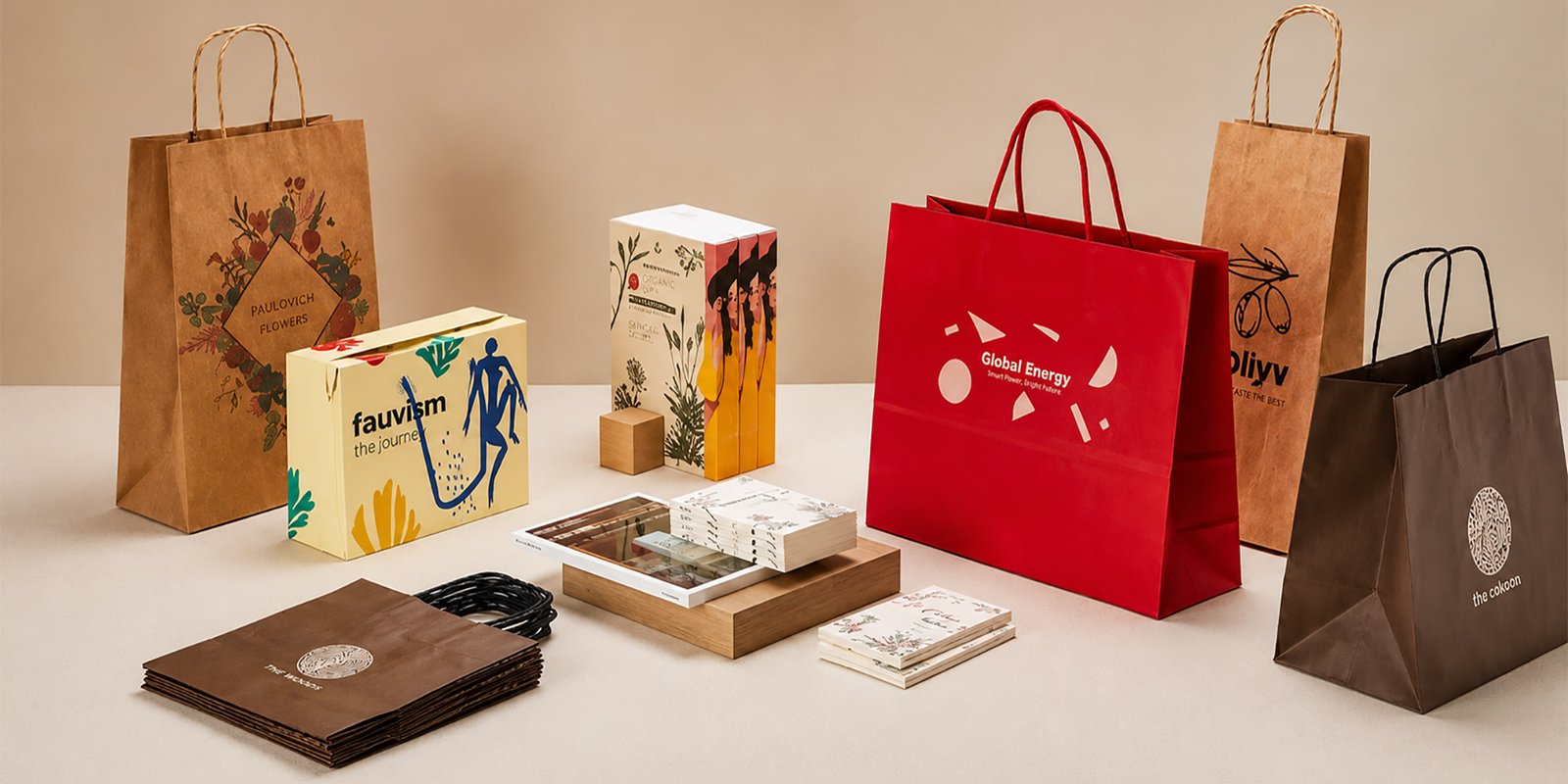
Bespoke paper bags UK pricing typically runs from around £0.35 to £1.20+ per unit, driven mainly by paper weight, handle type, and print method rather than the logo itself – get in touch for an exact quote against your spec. Most UK specialist printers set MOQs between 100 and 500 units. Twisted-handle kraft sits at the affordable end; laminated flat-handle bags with foil sit at the top.
If you’ve ever requested a quote for custom carrier bags and been surprised by how wide the price range came back, you’re not alone. Paper bags look simple from the outside – folded paper, a couple of handles, maybe a logo -but the pricing behind them depends on a handful of decisions most brands never think to make before they ask for a number. This guide walks through what actually drives the cost of bespoke paper bags UK brands order, so the quote you receive makes sense against what you’re holding.
What UK Brands Get Wrong Before They Even Request a Quote
Most retail and e-commerce brands go looking for custom printed paper bags with only a rough idea of size in mind, and nothing else specified. That’s the fastest way to end up with a quote that doesn’t match expectations, because paper weight, handle type, and finish move the price far more than the print itself does. A 130gsm kraft bag with a twisted paper handle and a 250gsm laminated bag with a rope handle can differ in cost by double, even at identical sizes. Knowing roughly how your product will be carried – grab-and-go retail, gift packaging, or heavier takeaway use – before requesting a quote makes the whole process faster, and the number you get back is far more accurate.
Why “Just Send Me a Quote” Rarely Works
Suppliers can’t price a bag they can’t picture. A request with no weight range, no handle preference, and no sense of finish leaves the supplier guessing at a mid-range spec – often either more expensive than the brand needs or too flimsy for what they’re actually packing. The brands that get accurate quotes fastest are the ones who’ve already thought through how the bag is used, not just how it looks in a mock-up render. Twenty minutes thinking about your product before that first email saves several rounds of back-and-forth later.
The Questions Worth Answering First
Before requesting pricing, it helps to have rough answers to a few things: how heavy is the heaviest item going in the bag, will the customer likely reuse it or bin it after one trip, and does it need to survive a walk home in the rain or just a five-minute trip from till to car? None of these need precise answers – a supplier can work with “somewhere around a kilo” or “mostly dry goods” – but having any answer at all narrows the spec dramatically and cuts out a lot of guesswork on both sides.
Which Paper Stock and Handle Type Honestly Fits Your Product?
Kraft paper bags are the standard starting point for most UK retailers, specified between 90gsm and 150gsm depending on load weight. Lighter stock works fine for boutique or gift use; anything carrying real weight – books, homeware, multiple items – needs to sit closer to 150gsm or move to a laminated stock entirely, similar in principle to the film-weight decisions behind kraft paper pouch packaging.
Kraft vs. Laminated: What the Distinction Actually Costs You
Lamination adds a thin plastic or varnish layer over the paper, giving the bag a glossier look and more resistance to moisture and tearing. It costs more per unit, but the distinction shows up fast for brands using bags for repeat handling, not a single handout. Kraft without lamination stays fully paper-based and is generally easier to recycle through standard streams, but it wears faster – tucking at the fold, tearing at stress points, losing shape sooner in damp conditions or under repeated handling. Lamination earns its cost when the bag needs to survive more than one trip, or when the product inside risks leaving oil or moisture marks on plain kraft.
Is a laminated paper bag as easy to recycle as plain kraft? Generally, no – the plastic or varnish layer bonded to the paper can make lamination harder to process through standard paper recycling streams than plain, uncoated kraft. If recyclability is a stated claim on the bag, check with your supplier exactly which lamination type they’re using and how it’s processed before printing that claim.
Twisted, Flat, or Rope: Matching the Handle to the Job
Handle choice matters more than most brands expect.
| Handle type | Typical cost tier | Best suited for |
|---|---|---|
| Twisted paper | Cheapest, standard | Most retail weights; first to fail under repeated heavy use |
| Flat paper | Slightly higher | Wider glue-patch contact spreads load more evenly; cleaner look |
| Rope (eyelet-fitted) | Highest – manual fitting step | Gift retail and luxury packaging, where presentation matters more than unit cost |
Twisted paper handles are glued through reinforced patches at the bag’s inner wall – fine for most retail weights but the first thing to fail under repeated heavy use. Flat paper handles give a cleaner look and slightly higher weight tolerance, since the wider surface distributes load more evenly across the glue patch. Rope handles sit at the top end, used almost exclusively for gift and luxury retail packaging, and add the most to per-unit cost because they’re fitted through eyelets instead of glued flat – a slower, more manual production step.
Will this bag be reused by the customer, or is it a one-trip carrier? That single question settles the GSM and handle decision faster than comparing spec sheets.
A Quick Note on Bag Sizing
It’s tempting to order one size that “fits everything,” but oversized bags waste material on every single unit you print, and that waste compounds fast across a few thousand units. Measure your product range’s smallest and largest likely items and size to the upper end of that range, rather than to an imagined worst case – it keeps material cost proportional to what you’re really shipping out the door.
The Finish Decision Most Brands Rush
Print method changes both the look and the minimum order size that makes financial sense. Flexographic printing is the standard choice for solid-colour branding and large logo placement, and it’s what keeps larger runs affordable. Digital printing handles full-colour, photographic-level detail and works at much lower volumes, but the per-unit cost climbs faster as order size grows – the opposite cost curve to flexo. Checking print method against order size before quoting matters, since recommending digital on a 2,000-unit run or flexo on a 150-unit run is one of the quickest ways to overcharge a client without meaning to.
Should I choose flexo or digital printing for my paper bag order? As a rough guide, flexo starts making financial sense once a run passes the low hundreds, because the plate cost gets spread across enough units to bring the per-bag price down. Below that, digital’s lack of plate setup usually wins out even though its per-unit ink cost is higher, since there’s no high fixed cost to absorb first. If you’re sitting right on that boundary – roughly 300 to 500 units – it’s usually worth asking for pricing both ways, since the exact crossover shifts depending on how many colours the design uses.
What Finish Extras Actually Add to the Price
Finish extras for custom paper bag printing – matte lamination, spot UV, foil stamping – sit on top of the base bag cost and are priced per finish, not bundled. A single foil logo on an otherwise plain kraft bag adds a modest cost; foil across a full pattern adds considerably more. Spot UV tends to land between the two, since it’s cheaper to apply than foil but always requires a separate finishing pass after printing. Matte lamination is the cheapest of the three finish choices and mostly changes how the bag feels and photographs rather than adding a visible branding element.
A common trap: ordering a small first batch with a premium finish (foil, spot UV) to “test the market,” then discovering the per-unit cost at 250 units is barely lower than at 100. Finish costs don’t scale down the way base paper cost does – if you’re testing, keep the finish simple and save the premium detail for the confirmed reorder.
Colour and Ink References Worth Knowing
Uncoated kraft interacts with ink differently to white or laminated stock, so colours that look punchy on a white background can read quieter on natural kraft. This isn’t a flaw – many brands lean into that warmer, textured look deliberately – but it’s worth ordering a physical print sample before committing a full production run to it, since screen colour and printed-on-kraft colour rarely match exactly.
MOQs, Turnaround, and What Honestly Changes the Price
UK specialist paper bag suppliers typically set MOQs somewhere between 100 and 500 units, with 100–250 the norm for brands ordering for the first time. Under that threshold, setup costs and plate charges for flexo, or digital file prep, add to the price – which is why very small orders always carry a disproportionately high per-unit cost regardless of paper or handle choice.
How Order Size Actually Moves the Per-Unit Price
| Order size | What to expect |
|---|---|
| 100–250 units | Highest per-unit cost of the three tiers – suits testing a design or a first retail batch, not chasing the lowest price |
| 250–500 units | Setup cost starts spreading thin enough to bring per-unit pricing down noticeably – often where a second order looks meaningfully cheaper than the first |
| 2,500+ units | Volume discounts typically kick in – this territory tends to belong to established retailers with a predictable reorder cycle |
What to Expect on Turnaround
Standard turnaround runs 12 to 14 working days from artwork approval, though rope-handle or heavily finished bags can push toward the longer end of that window, since eyelet fitting and multi-pass finishing both add production steps that plain flexo-printed kraft doesn’t need. It’s worth building that window into any launch or seasonal restock timeline rather than assuming a bag order can turn around as fast as a digital print job.
Reordering: Where Most of the Real Savings Show Up
The first order on any new spec almost always costs more per unit than it needs to, simply because setup and sampling are one-off costs baked into that first run. Once a brand has settled on paper weight, handle type, and finish, reorders on the same spec skip most of that setup cost entirely – a large part of why getting the spec right the first time, rather than iterating through several small test batches, tends to be the cheaper path overall.
What Getting the Spec Right Actually Looks Like
As an illustrative example: a homeware boutique had committed to a laminated, foil-branded bag at 150 units, based on a competitor’s sample they’d liked. Once the actual product weight and use case were worked through – mostly single-trip purchases carried a few streets home, not repeat-use shopping bags – they switched to a 150gsm kraft bag with a single flat handle and one spot-UV logo. The reorder six weeks later came in at close to the same unit price as the original quote, but for double the volume, because the spec finally matched what the bag actually needed to do. It’s a pattern worth noticing: the “impressive” sample bag and the right bag for a given product are rarely the same thing, and the gap between them is usually where the budget goes.
Getting the Order Right the First Time
The bags that end up looking most “premium” on a shop counter or in a customer’s hand are rarely the ones with every finish added on. Getting bespoke paper bags UK right comes down to a handful of decisions made early: paper weight matched to what the bag will actually carry, a handle type that fits how long it needs to last, and a print method that suits the order size you’re realistically placing. Get those three right, and the price you’re quoted stops feeling like a mystery and starts making sense against what you’re holding in your hands. The brands that come back for a second and third order tend to be the ones who treated that first spec as worth getting right, not the ones who chased the cheapest possible quote on round one.
Our cardboard display boxes and kraft paper pouch ranges pair well with bespoke carrier bags for retailers building a consistent unboxing and in-store experience.
Written by the Hale Path Packaging team.

Harry Taylor
Packaging expert at Hale Path Packaging, sharing insights on custom packaging solutions, sustainable materials, and industry trends.