Bespoke corrugated packaging UK typically pays for itself once order volume clears roughly 500-2,000 units, depending on box complexity – below that, a well-matched standard box usually costs less overall. Volume isn’t the only factor: fragile, irregularly shaped, or high-value products can hit break-even sooner, since damage and return costs outweigh tooling spend faster than unit price alone suggests. Flute grade – not the die-cut shape – is what actually determines whether a box protects a product, and it’s worth getting right before a bespoke die goes into production, not after.
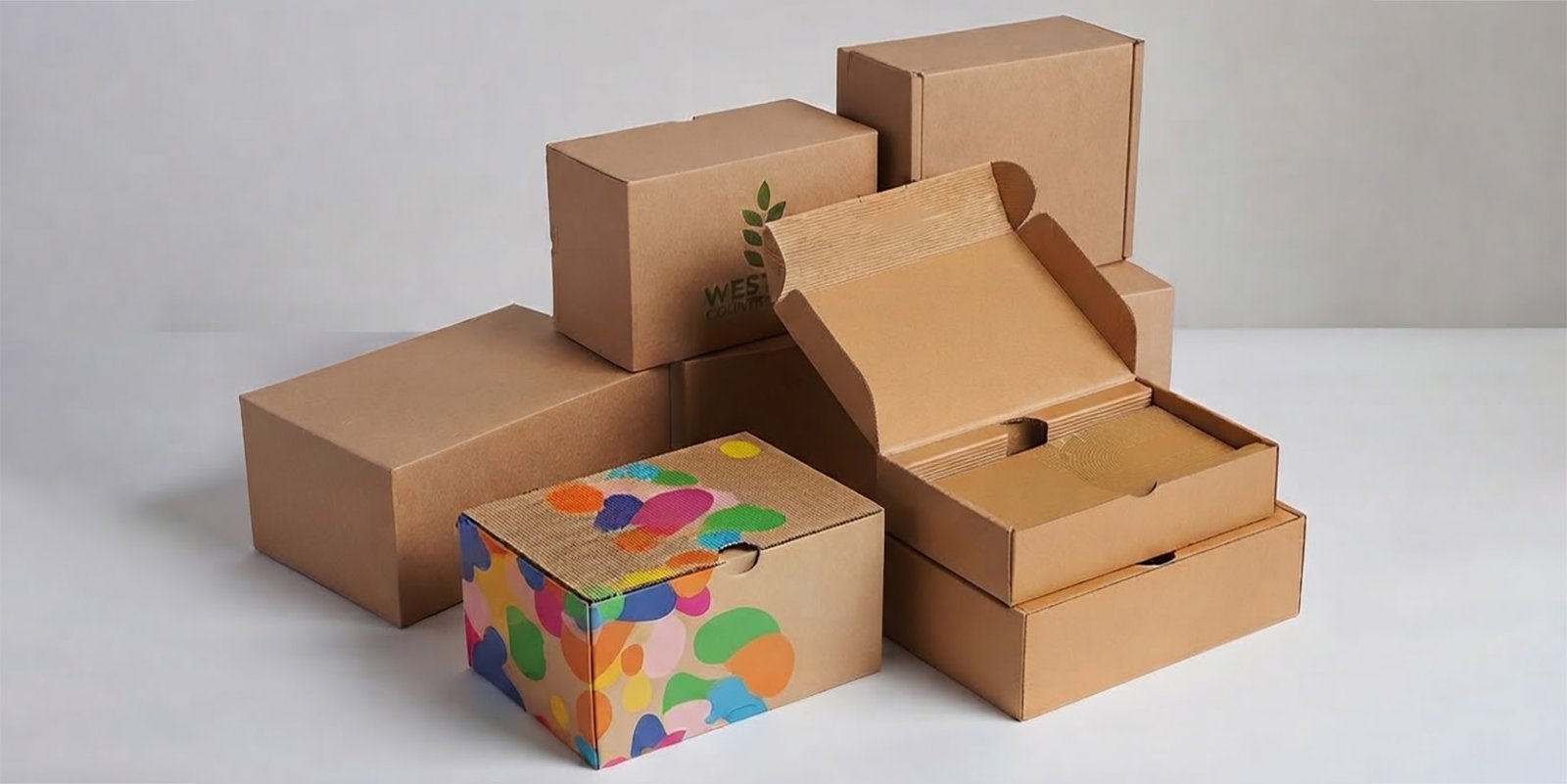
Bespoke corrugated packaging is sold by suppliers as an automatic upgrade. The honest answer is that it beats a standard box once volume, product fragility, or brand display genuinely require it – not before. A custom corrugated box requires die-cutting tooling paid upfront, and that cost only earns itself back once enough units are produced to spread it thin across the run.
This guide breaks down when bespoke corrugated packaging actually earns its cost, how to calculate your own break-even point, what actually drives box performance (it isn’t the shape), and where a stock box still wins even at scale.
The Question Most Suppliers Skip: Where’s Your Break-Even Point?
At what order volume does bespoke corrugated packaging become worth it? Bespoke corrugated packaging typically breaks even against a standard box somewhere between 500 and 2,000 units, depending on box complexity and finish. Below that range, a standard box usually costs less overall since there’s no tooling to amortise. Above it, a bespoke box usually costs less per unit, since it eliminates void fill and reduces dimensional-weight shipping charges that a standard box padded out to fit doesn’t avoid.
Most bespoke box suppliers have an obvious incentive to sell custom tooling regardless of order size, since the tooling fee itself is often a profit centre independent of the boxes it produces. A brand asking for a quote on 200 units of a fully bespoke die-cut box will usually get a price, not a conversation about whether that volume makes sense for the investment. This is where a lot of small brands overspend early – committing to a bespoke structure before their order volume has a realistic chance of clearing the setup cost in a sensible timeframe.
| Order volume | Standard box (with print sleeve) | Bespoke die-cut box | Better choice |
| Under 300 units | Lower cost per unit, no tooling fee | Tooling cost dominates per-unit price | Standard box |
| 300-1,000 units | Cost gap narrows as repeat sleeve/print runs add up | Tooling cost starts to spread thinner | Depends on fragility and brand need |
| 1,000-2,500 units | Repeat print and sleeve costs compound over time | Tooling fully amortised, void fill eliminated | Bespoke usually wins |
| 2,500+ units | Ongoing sleeve and void-fill cost compounds further | Lowest cost per unit, best shipping efficiency | Bespoke almost always wins |
These figures shift with box complexity and finish, but the shape of the curve holds across most UK corrugated manufacturer quotes.
Flute Grade Is the Decision That Actually Matters – Not the Die-Cut Shape
What’s the difference between B-flute, C-flute, and E-flute? C-flute is the general-purpose workhorse – it accounts for roughly 80% of all corrugated boxes made globally and offers the best stacking strength among single-wall grades for heavier or denser products, making it the default for general shipping and FMCG distribution. B-flute has a thinner profile that prints more cleanly, which has made it increasingly popular for branded UK D2C boxes under about 5kg, even though it offers somewhat less cushioning than C-flute. E-flute is thinner again, suited to lighter retail products where shelf presentation and a tight, refined fold matter more than raw crush strength.
Flute types are organised under standard FEFCO codes used across European corrugated manufacturing – worth knowing when comparing quotes between suppliers, since “heavy-duty” on a spec sheet means nothing without a flute grade and ECT rating attached to it.
Board weight (GSM) works alongside flute grade, not instead of it – a heavier liner on the wrong flute grade won’t fix a structural mismatch. ECT (Edge Crush Test) is the number that actually predicts stacking strength, and it’s worth asking for directly rather than trusting a generic “heavy-duty” label. A standard B-flute single-wall box typically carries a 32 ECT rating; double-wall construction typically starts at 44-51 ECT.
Does corrugated board lose strength if it gets wet or humid? Yes, significantly. Corrugated board can lose 40-70% of its rated stacking strength when exposed to moisture, regardless of flute grade. A box rated at 32 ECT in dry warehouse conditions may be performing at effectively 10-19 ECT after several hours in a humid delivery vehicle or during cold-chain transport. This is a separate specification decision from flute grade – a moisture-resistant coating or liner treatment matters as much as the grade choice itself for anything shipped in variable UK weather. Source: Wabs Print’s corrugated box grades guide.
Matching Flute Grade to Product Type
A brand shipping glass jars or ceramic objects needs C-flute or double-wall corrugated regardless of whether the box ends up custom or standard, since the flute grade is doing the structural work, not the die-cut shape. A brand shipping lightweight clothing or soft goods can often use E-flute even in a bespoke run, since the product doesn’t require heavy crush resistance, and a lighter flute keeps material cost and dimensional weight down. Getting this matched correctly before committing to a custom die avoids paying tooling costs for a structure that was never going to solve the protection problem in the first place.
Does Custom Fit Actually Save Money on Shipping?
Can a custom-sized box actually reduce shipping costs? Yes, mainly through dimensional weight. UK carriers increasingly charge by box volume as much as actual weight, so an oversized standard box padded out with void fill often costs more to ship than a snug bespoke box costs to produce. Void fill itself – air pillows, paper crumple, foam inserts – adds cost per shipment and protects nothing that a correctly sized box wouldn’t already protect on its own; it’s purely compensating for a box that’s the wrong size. Snug-fit bespoke boxes reduce both the void-fill cost and the dimensional-weight charge simultaneously, which is where shipping savings compound fastest.
This saving only shows up at volume, though. A single small order doesn’t generate enough shipping data to notice the difference meaningfully, and the tooling cost for a one-off bespoke run can easily outweigh whatever gets saved on postage across a handful of shipments.
How many parcels a month before shipping savings alone justify bespoke tooling? A brand shipping a few hundred parcels a month through a standard courier will often see the dimensional-weight penalty add up to a noticeable monthly cost once totalled across a quarter. At that point – setting the branding benefit aside entirely – a bespoke box sized precisely to the product can pay for its own tooling through shipping savings alone within a few months. Worth calculating separately from the branding decision, since it’s a purely financial case that doesn’t depend on unboxing experience at all.
Three Questions to Ask Before Committing to a Bespoke Run
Answer these honestly, rather than assuming the answer is automatically yes because bespoke sounds like the premium option.
- Is your monthly volume realistically going to clear the tooling cost within a reasonable timeframe – a number based on your actual current order rate, not a hopeful projection?
- Does your product’s fragility genuinely need a structure a stock box can’t provide, or is a stock box with the right flute grade and board weight already doing that job adequately?
- Is the unboxing experience actually part of your brand’s value proposition, or is it something that felt like the right thing to add without a clear commercial reason behind it?
Why do brands overspend on bespoke packaging so often? Brand presentation is the easiest justification to reach for, because it’s the hardest one to disprove – nobody can definitively say a bespoke box didn’t help brand perception. But it’s also the easiest place to overspend, since the actual commercial return on unboxing polish is much harder to measure than the return on shipping savings or product protection. A corrugated box manufacturer worth working with will ask about volume and fragility before quoting a bespoke die, not after the tooling invoice has landed.
A Common Pattern Worth Recognising: The “Not Yet” That Becomes “Now”
This is a pattern that shows up repeatedly with early-stage brands, not a single business’s story: a brand launching a new product wants a fully bespoke die-cut box from day one, expecting to order around 300 units to start. At that volume, the tooling cost alone typically adds more to the per-unit price than a well-matched stock box with a printed sleeve would cost overall, once the full comparison is worked through properly.
The right call in a case like this is usually to hold off on bespoke tooling, run the launch on a stock box with custom printing instead, and revisit bespoke tooling once monthly volume clears a few thousand units. Several months later, once volume has genuinely grown, the standard-box-with-sleeve approach often starts costing more per month in repeat print runs and void fill than a bespoke die would cost to set up and amortise – which is the point where “not yet” becomes “now,” and the bespoke die gets commissioned using real sizing and fragility data gathered during the stock-box period, getting the structural design right the first time instead of guessing at launch.
The Bottom Line
Bespoke Corrugated Packaging UK is genuinely worth it – but not automatically, and not at every volume. The honest version of this decision comes down to three things: whether order volume realistically clears the tooling cost within a reasonable timeframe, whether product fragility genuinely requires a structure a well-matched standard box can’t already provide, and whether the unboxing experience is doing real commercial work for the brand rather than just feeling like the premium thing to do.
For low-volume launches, a standard box with the right flute grade, board weight, and a custom print sleeve is the smarter starting point, with bespoke tooling revisited once monthly volume grows into the thousands. For brands already shipping consistent volume, the dimensional-weight and void-fill savings alone often justify the switch before branding even enters the conversation. Getting the flute grade and ECT rating right matters more than the die-cut shape – and a corrugated box manufacturer that asks about your volume and fragility needs before quoting a bespoke die is the one worth working with either way.
Hale Path Packaging works through this exact break-even calculation with brands before recommending bespoke tooling – flute grade, ECT rating, and moisture resistance specified against your actual product and shipping conditions, not sold as a default upgrade.
Get a quote and talk through your break-even point, or browse our custom corrugated boxes range.
Related: Custom Corrugated Boxes · Packaging EPR UK for Small Businesses · Custom Packaging for Small Business UK

Harry Taylor
Packaging expert at Hale Path Packaging, sharing insights on custom packaging solutions, sustainable materials, and industry trends.