
Custom Card Game & Tuck Box Printing UK: MOQs, Card Counts & Box Formats Explained
Quick answer: The box for a card game usually costs more to specify correctly than the cards themselves, mainly because most printers won’t touch an order under a few thousand units; a wall most first-time designers hit at the quote stage. The fix is a digital-print supplier with realistic low-volume MOQs (100-250 units) and the right box format matched to your actual card count: a tuck box for anything under roughly 110 cards, a two-piece box above that, or wherever extra components are involved. This guide covers card stock, box formats, realistic MOQs, and real 2026 costs.
Ever wondered why the box for your card game ends up costing more to get right than the cards inside it? A first-time game designer usually finds two things out at the same quote stage: the box is the harder, pricier part to specify correctly, and most printers won’t touch an order under a few thousand units. A different box structure and a different digital-print supplier fix both problems for most first-time designers running into the same wall.
This guide covers what actually matters when specifying card game packaging in the UK: card stock, box formats, realistic MOQs, and what it all costs in 2026.
Card Game Packaging UK: Card Stock Is the Decision That Affects Everything Else
What card stock weight is standard for a custom card game? 300-350gsm is the standard range for most card games; thick enough to feel substantial, not so stiff it fights the shuffle. Below 300gsm, cards start feeling cheap and floppy, which is one of the most common under-specification mistakes first-time designers make.
- Black core card stock. A black layer between the two paper layers stops light from showing through the card; matters for any game where players shouldn’t be able to identify cards by holding them up to the light.
- Linen finish playing cards. Textured, fabric-like coating. Resists fingerprints and scuffing, shuffles smoothly. Costs more, but worth it for a deck that gets shuffled often.
- Gloss finish card printing. Makes colours pop, good for visual impact. Shows fingerprints easily and can feel slightly slippery to shuffle. Better suited to a party game played once than a strategy game shuffled every session.
Tuck Boxes vs Two-Piece Boxes vs Magnetic Closures
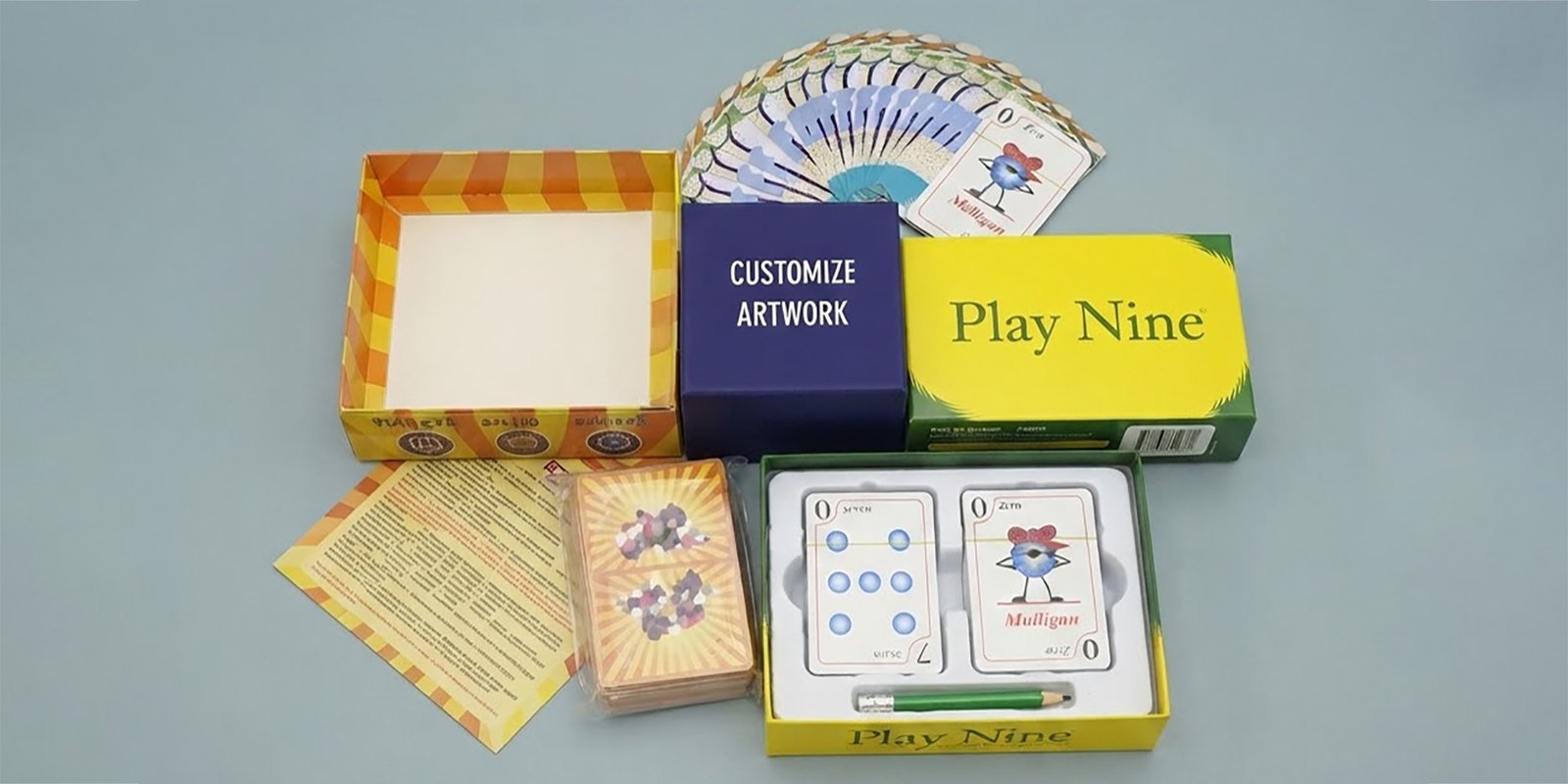
What’s the difference between a tuck box and a two-piece card game box? A tuck box is a single piece of card folded and glued into a box with a tuck flap closure; the cheapest format per unit, fast to assemble, and the format used for most commercial playing card decks. It works well for decks under roughly 110 cards. A two-piece box, with a separate base and lid, handles larger card counts and heavier components (dice, tokens, a rulebook) that a tuck box’s folded structure isn’t built to support. It costs more per unit but holds its shape better under the weight of a fuller game and doesn’t wear out at the tuck flap the way a tuck box does after repeated opening and closing.
Magnetic closure boxes sit at the premium end, typically reserved for higher-priced games, collector’s editions, or custom trading card packaging aimed at a premium market; similar to the closure tier available on our Credit Card Box UK range, where the same magnetic-vs-tuck-end decision applies. The magnetic closure feels substantial and reduces the risk of components spilling out compared to a simple lid, but the tooling and material cost are meaningfully higher than either a tuck box or a standard two-piece box.
Playing card box printing for a standard 54- to 56-card deck almost always defaults to a tuck box, since the format has become the expected standard for that card count, and deviating from it without a strong reason can read as unfamiliar to a customer used to a specific unboxing motion.
| Format | Best for | Card count | Cost per unit | Durability |
| Tuck box | Standard decks, single-deck games | Under ~110 cards | £ (lowest) | Wears at the tuck flap over time |
| Two-piece box | Larger decks, extra components | ~80-300+ cards | ££ | Holds shape well, no flap wear |
| Magnetic closure | Premium and collector’s editions | Any, size-dependent | £££ (highest) | Most durable, secure closure |
How many cards fit in a standard tuck box? A standard tuck box holds up to 110 cards in a single deck, or 220 cards across two decks packed side by side. Games with more cards than that need a two-piece box for better durability. Source: PrintNinja’s tuck box packaging specification, cross-checked against five other UK and US card game printers stating the same capacity.
Realistic Card Counts and What They Mean for Box Choice
A standard playing card deck sits at 52 to 56 cards, comfortably within tuck box territory. Most party games and light card games land somewhere between 80 and 150 cards, which is where the tuck box versus two-piece decision starts to genuinely depend on the specific box dimensions rather than a hard card-count rule.
Board game box printing for anything beyond a card-only game needs to account for insert space, dice, tokens, and a rulebook, not just the cards themselves. A box sized purely around the card count without leaving room for these components ends up either too tight to close properly or requiring a redesign after the prototype comes back from the printer; both cost time and money that a slightly more generous initial sizing would have avoided.
Games with expansion packaging or add-on decks need to think about box sizing beyond the base game from the outset, since a box sized exactly to the base game’s card count leaves no room for an expansion pack later, forcing either a full box redesign or an awkward separate expansion box that doesn’t match the base game’s shelf presence.
- 52-56 cards — standard playing card deck: tuck box.
- 80-150 cards — party games, light card games: tuck box or two-piece, depending on dimensions.
- 150-300+ cards — deck-builders, games with components: two-piece box, often with an insert.
- Any count, plus expansions — games with add-on content: two-piece, sized with expansion room from the start.
MOQs: What’s Actually Achievable for a First Print Run
What is a realistic MOQ for a first custom card game print run? Traditional offset print MOQs, the standard for large publishers, typically run in the thousands, sometimes tens of thousands, for full-colour card printing with a matching custom box; a pricing model that assumes a publisher who already knows the game will sell in volume, which describes almost no first-time independent designer. Digital print, increasingly common among UK card and board game printers serving the independent and crowdfunding market, brings that minimum down to the hundreds; sometimes as low as 100 to 250 units for a first run. The per-unit cost is higher than offset at scale, but for validating a game through a crowdfunding campaign or a small initial retail test, it’s the only realistic route.
Custom card boxes, specifically, often have their own MOQ that doesn’t automatically match the card print run; checking both numbers before committing to a supplier matters, since a designer can end up with print-ready cards and no box able to ship them at the volume actually needed. Our Custom Game Cards and Custom Playing Card Boxes pages list current MOQ tiers for cards and boxes separately, which is worth checking against each other before committing to a supplier for either.
What Card Game & Tuck Box Printing Actually Costs in the UK in 2026
Standard tuck box pricing with full-colour custom print runs roughly £0.30 to £0.80 per unit at digital print volumes of a few hundred units, dropping to £0.10 to £0.30 at offset volumes in the thousands.
Playing card printing cost, on 300 to 350gsm black core stock with a linen finish, typically runs £0.02 to £0.06 per card at moderate volumes — meaning a 54-card deck’s card cost alone lands somewhere between £1 and £3 before the box is even factored in.
Two-piece box pricing costs more than tuck boxes, generally £0.50 to £1.50 per unit, depending on size and whether an insert tray is included. Magnetic closure box pricing runs from £1.20 to £3.00 per unit, reflecting both the tooling complexity and the material cost of a rigid board structure with a fitted magnet.
Digital print for low-volume runs has genuinely changed what’s achievable for a first-time designer, making a properly printed, boxed game possible at the kind of volume a crowdfunding campaign or a small print-on-demand launch actually needs.
Material and Regulatory Notes for 2026
Card game packaging is almost entirely paper and card, which sits outside the scope of the UK Plastic Packaging Tax for the box and cards themselves; though shrink wrap used to seal a finished box is plastic and does fall under the tax if it doesn’t meet the 30% recycled content threshold. Cellulose-based shrink wrap, which behaves similarly to plastic shrink film but is compostable, has become a realistic alternative for smaller UK printers serving the games market specifically.
Does the UK plastic packaging tax apply to card game boxes? No, not to the box or cards themselves – card game packaging is almost entirely paper and card, which falls outside the scope of the tax. It does apply to any plastic shrink wrap used to seal the finished box, unless that shrink wrap contains at least 30% recycled content or is a cellulose-based compostable alternative.
Sourcing credentials on the board itself are now standard across most UK card and box printers serving this market, which matters increasingly to backers on crowdfunding platforms who actively look for that kind of assurance before pledging to a new game.
Questions Worth Asking Before You Commit to a Print Run
- Shuffle-tested stock? Has the card stock actually been tested for shuffleability at the intended weight and finish, or is the spec based on a supplier’s general description rather than a physical sample in hand?
- Box matched to the game? Does the box format genuinely suit the card count and component list, or was it chosen because it looked good in a reference image from an established publisher’s game?
- Matching MOQs? Is the MOQ quoted for the cards and the box the same number, or could a designer end up with printed cards and no matching box at the volume actually needed?
- Room for expansion? If planning expansion content, has box sizing accounted for that from the start, or will the base game box already be too tight to accommodate it later?
- Physical proof checked? Has a physical proof actually been requested and checked in hand before committing to the full print run, rather than approving based on a digital mockup? Colour, card feel, and box fit can all look right on screen and still come back wrong once printed.
The Bottom Line
Card game packaging UK specifications fail in a specific, predictable way: a box specced around the wrong card count, a stock chosen without an actual shuffle test, or an MOQ quoted from a supplier built for publishers rather than independent designers. Getting card stock, box format, and MOQ aligned with the actual game and the actual print run size protects both the budget and the launch timeline.
Match the box to the card count, test the stock before committing to a full print run, and check that the card game print MOQ on the box matches the MOQ on the cards before signing off on either.
Get a quote for your card game packaging, or browse our Custom Game Cards and Custom Playing Card Boxes ranges directly.
Related: Custom Game Cards · Custom Playing Card Boxes · Credit Card Box UK · Business Card Box UK · Sleeve & Tray Rigid Boxes
Written by the Hale Path Packaging team, packaging specialists with over a decade of experience supplying card game, board game, and trading card packaging to independent designers, publishers, and crowdfunding creators across the UK, working directly with first-time designers on print-ready file checks and low-volume digital print runs.

Harry Taylor
Packaging expert at Hale Path Packaging, sharing insights on custom packaging solutions, sustainable materials, and industry trends.