

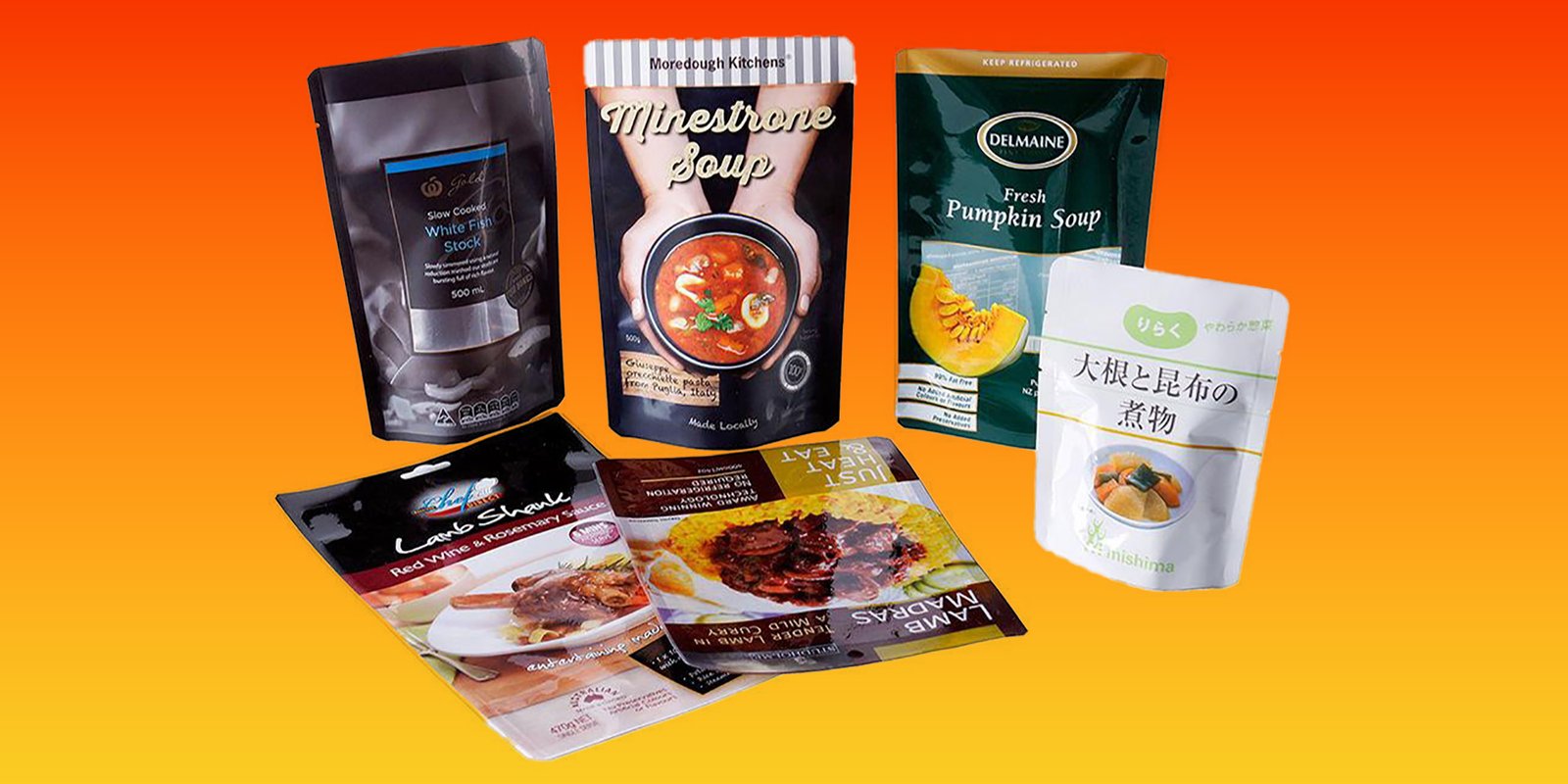
Most food brands run into retort pouches UK in one of two ways. Either a retailer spec mentions them, and nobody’s quite sure what sets them apart from a standard high-barrier pouch, or a competitor switches over, and the question becomes whether to follow, usually leading to a first call with retort pouch suppliers in the UK. This guide answers both situations plainly: what retort pouches uk are, when they’re right, what they cost in 2026, and how regulation is shifting the maths.
What a Retort Pouch Actually Is, and What Makes It Different From a Standard Pouch
What is a retort pouch, and how is it different from a standard pouch? A retort pouch is a multilayer laminated flexible pouch built to survive thermal processing, the step that sterilises whatever’s inside after sealing. Food goes in, the pouch is sealed, and it goes into a retort chamber: a high-pressure industrial steriliser running at around 121°C for 15 to 30 minutes, depending on the product. That heat kills bacteria and pathogens to commercial sterility standards, giving the product 12 to 24 months of ambient shelf life without refrigeration. Whichever retort pouch manufacturers UK brands work with, the processing logic stays the same regardless of structure.
That’s the whole reason retort packaging UK exists. Not the material, not the format, just the ability to sterilise a sealed pack and get ambient shelf life on something that would otherwise need chilling or freezing. If your product doesn’t need ambient shelf life, you don’t need a retort pouch, full stop. The same logic runs through most packaging categories we work in, from coffee packaging in the UK to regulated food formats. Sounds obvious, but plenty of UK food brands get this backwards: some pay for retort pouches uk when a standard high-barrier pouch would do for less, and others run standard pouches on products that genuinely need retort processing, then can’t work out why shelf life keeps falling short.
When You Actually Need a Retort Pouch uk, and When You Do Not
FAQ: What products actually need retort pouch packaging? You need a retort pouch when your product’s wet and protein-heavy, meat, fish, beans, pulses, dairy-based sauces, baby food, wet pet food, and it’s meant to sit on an ambient shelf for a year or more with no preservatives propping it up; this is your format. It’s the retort pouch food packaging process that makes that possible, not the pouch itself; the heat does the actual work. This kind of regulated, food-contact category demands the same discipline seen across other compliance-heavy packaging formats, where the format has to satisfy both a technical function and a compliance requirement at once.
Ready meals heading to UK supermarket shelves fall into this category, often in stand-up retort pouches uk rather than flat pillow formats, since a stand-up base makes microwave heating and shelf presentation easier. So do wet pet food packaging sold in the ambient aisle, baby food retort pouches uk, camping and emergency food, and any convenience food positioned for markets where refrigeration is unreliable. We’ve seen brands in all these categories come to us after running standard high-barrier pouches on products that needed retort processing, finding shelf-life failures at three to four months that a proper retort structure would have prevented.
You do not need a retort pouch when your product is dry. Coffee, tea, spices, snacks, flour, that sort of thing doesn’t need thermal sterilisation, because without moisture there’s nothing for microbes to grow in. A standard high-barrier pouch does the job for less. Putting retort pouches on dry products is money spent for no reason, usually a sign the format was specced without understanding why retort processing exists.
You also don’t need one if your product is going into cold chain distribution and staying there. Chilled products with a short shelf life, fresh soups, chilled ready meals, and short-date sauces are kept safe by the cold chain, not thermal sterilisation. A high-barrier pouch or film-lidded tray, part of the wider flexible food pouches UK category, handles those without the added cost of flexible retort packaging.
The Benefits That Actually Matter for UK Food Brands in 2026
Ambient shelf life without preservatives. This is the main benefit, really the whole reason the format exists. Once a product’s been retort-processed and sealed, it gets 12 to 24 months of ambient shelf life from heat alone, not preservatives. As a category of ambient food packaging in the UK, retort pouches solve a problem chilled or frozen formats simply can’t. That matters if you’re positioning on clean label, and even more for brands supplying export markets or humanitarian food programmes, where sterilised pouch packaging UK can be the difference between a product surviving the journey or not. High-barrier retort pouches UK hold up over those longer routes, where a product might sit in transit for months.
Do retort pouches actually reduce plastic weight compared to trays or cans? Yes, significantly. A retort pouch typically uses around 70% less plastic by weight than an equivalent CPET tray and lid, and considerably less than a steel can carrying the same product. That’s not just an environmental metric; it’s a direct input into UK EPR fee calculations. With EPR fees rising through 2025 and 2026, every gram removed from the pack cuts producer liability directly. Brands switching from cans to retort pouches are seeing measurable pEPR cost reductions that partially offset the unit cost difference, especially visible in pet food retort pouches UK, where brands moving off tins cut both material weight and producer fees in one decision. Source: Aropack’s flexible packaging for ready meals report, which cites the same 70% figure against CPET trays specifically.
Distribution efficiency. Retort pouches UK are flat when empty, stack efficiently when filled, and weigh less than cans carrying the same product weight. That means lower freight costs per pallet, better cube efficiency in storage, and a reduced carbon footprint, a metric UK retail buyers increasingly ask about at range review. It’s one reason ready meal retort pouches UK have gained shelf space at the expense of trays.
Retailer specification compliance. Tesco, Sainsbury’s, Waitrose, and M&S have all published specs moving away from formats they consider hard to recycle. The tri-laminate retort pouch, typically PET/aluminium/PP or PET/aluminium/PE, sits in a tricky spot on recyclability because the layers can’t be separated. UK roasters supplying the same retailers under coffee packaging UK specs have faced an almost identical shift away from foil laminates. Demand for mono-material retort options has grown significantly as a result. Mono PP retort pouches UK, which run through polypropylene recycling streams, are now a realistic alternative for brands needing both ambient shelf life and credible recyclability. Brand owners specifying custom retort pouches UK increasingly build this into the brief from the start rather than retrofitting later.
What Retort Pouches Actually Cost in the UK
Prices for retort pouches UK in 2026 land between £0.08 and £0.35 per unit. Getting a handle on retort pouch packaging cost in the UK means understanding what drives that range, since size, structure, print, and order volume all push it around, and the range isn’t that useful on its own without knowing which factor applies to your pouch.
Structure is the biggest variable. A standard tri-laminate PET/aluminium/PP structure costs less per unit than a mono-PP retort pouch structure, which requires more specialised film and currently runs at a slight premium, since most retort pouch film suppliers across Europe are still scaling up mono-PP production volumes. High-pressure processing-compatible structures and transparent retort pouches UK, where clarity replaces aluminium, sit at the higher end of the range.
Fill weight and size affect cost because larger pouches use more material and require different sealing parameters. Retort pouch sealing has to be validated separately for each fill weight and structure combination, since a seal that holds on a 100g baby food pouch won’t necessarily hold the same way on a 400g ready meal pouch in the same structure.
Is retort processing itself included in the pouch price? No; retort processing is a separate cost from the pouch itself. Buying pouches and running them through your own or a co-packer’s retort is a processing cost that sits outside the unit cost, and some UK food brands are surprised to learn that the pouch supplier and the retort processing are two entirely separate conversations, each with their own supplier relationship and cost structure to manage.
The Regulatory Picture in 2026 and What It Changes
The UK plastic packaging tax, rising to £228.82 per tonne in April 2026 for packaging without at least 30% recycled content, applies to the multi-layer laminate structures that most retort pouches UK use. Aluminium-containing laminates typically can’t incorporate recycled content without compromising barrier performance, so the tax applies in full to standard tri-laminate pouches.
Mono-PP retort pouches partially address this. Polypropylene incorporates recycled content more readily than a laminate, and mono-material structures sit better against both the tax and OPRL claims than aluminium-containing ones. This push isn’t unique to food either; it’s the same shift reshaping sustainable packaging in the UK across clothing and fashion. Retort pouch recycling UK infrastructure is still developing, but mono-material formats are best positioned to use it as kerbside collection expands.
The Simpler Recycling kerbside rules rolling out by March 2027 add further urgency. Retort packaging that can’t be collected at kerbside will face growing retail buyer resistance as retailers align with the incoming rules. Most retailers now expect BRCGS Packaging Materials certification from any converter supplying retort structures for food contact, and brands specifying rigid pouch packaging in the UK should now design against both the 2027 deadline and that certification expectation.
The Questions Worth Asking Before You Specify a Retort Pouch
- Does this product actually need ambient shelf life, or is it going into the cold chain? If cold chain, a standard high-barrier pouch is simpler and cheaper.
- What is the target shelf life, and at what temperature? 12-month ambient needs different processing parameters than 24 months, and retort pouch shelf life depends on the structure matching the actual processing conditions, not just the pouch material on its own.
- What is the retailer specification, and has OPRL pre-assessment been requested for every candidate film? A cook trial in conditions that replicate the consumer oven or microwave, not a lab oven, catches seam creep and hot spots before a listing commitment is made. If testing a new product with a small print run first, the same trial order principles apply; don’t commit to full retailer volume before the cook trial confirms the structure holds up.
- Is the mono PP retort pouch UK option worth the current unit cost premium given the pEPR and recyclability trajectory? For brands thinking 18 to 24 months ahead, the answer is increasingly yes.
The Bottom Line
Retort pouches UK solve one problem: getting moisture-containing food to sit safely on an ambient shelf for 12 months or longer without refrigeration. When that’s your problem, they’re the right answer. When it’s not, they add cost and complexity for no return. The same principle holds across every regulated category we work in: match the format to the actual requirement, not the trend.
The regulatory pressure in 2026 is pushing toward lighter, recyclable structures, and Mono PP retort is where that pressure meets what retort processing actually needs. The cost premium is narrowing, and for brands thinking 18 to 24 months ahead, the case for specifying it now is stronger than most have worked out yet.
Get a quote for your retort pouch packaging, or browse our flexible packaging and pouches range.
Related: Coffee Packaging UK · Flexible Packaging & Pouches · Packaging EPR UK for Small Businesses
Written by the Hale Path Packaging team, packaging specialists with over a decade of experience supplying retort, flexible, and food-grade packaging to food manufacturers and retail brands across the UK, working with BRCGS-certified converters on structure trials and retailer submissions.

Harry Taylor
Packaging expert at Hale Path Packaging, sharing insights on custom packaging solutions, sustainable materials, and industry trends.