Coffee Packaging UK: Bag Types, Valve Guide & Real 2026 Pricing
Getting coffee packaging UK right comes down to three things: format matched to sales channel (not aesthetics), a degassing valve sized and placed correctly for whole bean versus ground coffee, and a material choice that now has to weigh 2026’s Plastic Packaging Tax (£228.82/tonne on non-recycled plastic) and the 2027 Simpler Recycling deadline against barrier performance. Get those three right and the pricing conversation – from £0.08 stock bags to £0.60 custom-printed pouches – becomes straightforward, because every variable in it is already defined.
Ask a roaster about their roast profile and you’ll be there a while – test batches, burnt fingers, cupping sessions dragging past midnight. Ask about the bag, and the answer’s usually shorter: “took me twenty minutes, honestly.” That mismatch is the problem. The coffee bag is where a lot of that hard-earned freshness leaks out, where the brand either looks right on a shelf or doesn’t, and where an unexpected regulatory cost tends to turn up long after the order’s gone in.
The Bag Format Decision Is a Coffee Packaging Sales Channel Decision, Not an Aesthetic One
Most roasters start the format conversation in the wrong place – picking whatever looks best, then finding out later it doesn’t suit how the coffee actually gets sold or shipped.
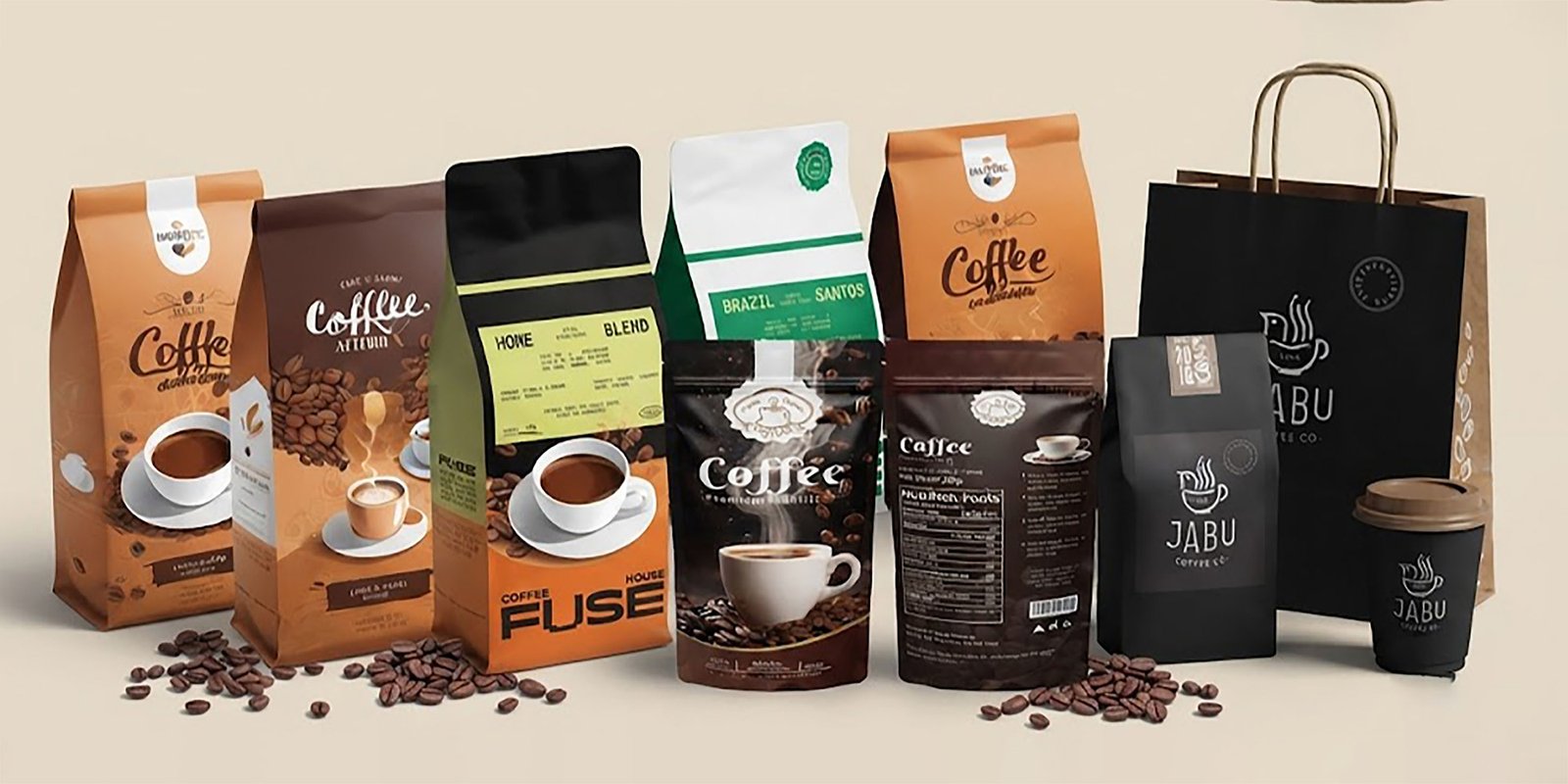
Box bottom (flat bottom) bags stand square on a shelf without support and hold their shape even half-empty. Genuinely useful in an independent coffee shop or speciality grocery, where the bag faces outward for days at a time. It matters far less for a subscription roaster shipping direct to the customer, since the bag goes straight into a mailer and nobody ever sees it standing up. Paying extra for a box bottom format on a subscription-only product is money spent on something nobody will notice.
Side gusset bags cost less per unit, fill faster by hand, and work well for wholesale sizes from 250g up to 5kg. The trade-off is shelf presence – a side gusset bag doesn’t stand as neatly as a box bottom and can look less considered in a retail display. Most roasters selling into both retail and wholesale end up running two formats side by side: box bottom for anything customer-facing, side gusset for wholesale and high-volume subscriptions.
Stand-up pouches are the format you’ll see most across UK speciality coffee, mainly because they do an adequate job for both retail and wholesale without being perfect for either. If you’re building out a retail presence for the first time, this is usually the sensible place to start before volume justifies anything more specialised.
Flat pouches and drip bags are for samples, single-serve, and trial packs. The drip bag – a flat pouch with a built-in filter – has become a genuinely popular gifting and sampling format in UK speciality coffee over the last few years. It’s cheap to produce, and the margin on a four-bag gift pack often beats what you’d make on a standard 250g retail bag.
What size coffee bag should I use? As a working guide: 70-100g suits samples and trial packs, 250g is the most common UK retail size, 500g covers retail and small wholesale, and 1kg is standard for wholesale and hospitality accounts. Whole beans take up more room than ground coffee at the same weight, so size up if you’re between two options.
| Fill weight | Typical use |
| 70-100g | Samples, trial packs, subscription add-ons |
| 250g | Standard UK retail – the most common single size |
| 500g | Retail and small wholesale |
| 1kg+ | Wholesale and hospitality |
Coffee Packaging UK: The Valve Question Most Roasters Answer Too Simply
“Yes, if it’s fresh coffee.” That’s the standard answer roasters get when they ask whether they need a valve — not wrong, just incomplete. It skips valve size, placement, and the specific problem that shows up when a valve made for whole beans gets used on ground coffee instead.
Do I need a valve on my coffee bag? Roasted beans keep releasing CO2 for days after roasting, not just while they cool. A one-way degassing valve lets that gas escape while keeping oxygen out. Skip the valve and seal within 72 hours, and the pressure has nowhere to go – the bag puffs up and loses its shape. Wait longer to seal instead, and the beans sit exposed, going stale before they’re even packed. Fitting the valve is what avoids both problems. Fully degassed coffee, instant coffee, and drip bags generally don’t need one.
Here’s the part most guides leave out: ground coffee doesn’t behave like whole beans. It degasses faster, simply because there’s more surface area per gram once it’s ground, and it throws off fines – tiny particles that work their way toward the top of the bag during handling. Put a valve dead-centre over a bed of ground coffee and those fines will clog it within days. From the outside, the bag still looks fine. Inside, the valve has stopped working, pressure builds, and eventually the seal fails.
That’s why ground coffee gets an off-centre, slightly recessed valve as standard – not a premium upgrade, just the correct spec. A valve sitting dead-centre on a bag of ground coffee is a valve that’s going to clog sooner or later.
Where should the valve be placed on a ground coffee bag? Off-centre and slightly recessed, not in the middle of the bag. Ground coffee throws off fine particles that migrate upward during handling and settle directly under a centred valve, clogging it within days even though the bag looks fine from the outside. Whole bean coffee doesn’t have this problem to the same degree, since there’s far less fine particulate to migrate.
Decaf is where this coffee packaging conversation changes entirely – not because roasters remove valves without reason, but because decaffeination strips out much of what would normally produce CO2, so decaf simply doesn’t degrade the way caffeinated coffee does. What’s a genuinely live issue for decaf specialists right now isn’t whether to include a valve – it’s whether the valve itself can be recycled. UK decaf roaster Decaf Nation has said directly: “our valves are not recyclable as of yet… This is something we are looking into, as we continue to focus on sustainability practices within the business.” That’s a real, current tension in the industry – a functional necessity (the valve) sitting at odds with a recyclability goal – and it’s exactly the kind of trade-off the Simpler Recycling deadline below is about to make unavoidable for every roaster, not just decaf specialists. Source: Decaf Nation, quoted in MTPak Coffee.
Why the Coffee Packaging UK Material Decision Has Become Complicated in 2026
Go back three years and choosing a coffee packaging UK material was a fairly quick call. Wanted maximum barrier performance? Foil laminate. Wanted a more natural look? Kraft-PE. Sustainability the whole brand story? Compostable kraft-PLA. Regulation has since made all of that messier.
The UK Plastic Packaging Tax, now £228.82 per tonne, applies to any plastic packaging that doesn’t hit at least 30% recycled content. Standard foil laminates – PET/aluminium/PP or PET/aluminium/PE — generally can’t take on meaningful recycled content without their barrier performance suffering, so the tax lands on them in full. For a roaster ordering 50,000 bags a year, that’s a real cost that simply wasn’t part of the equation two years ago. Source: Rödl & Partner’s PPT 2026 rate guide.
Mono-material coffee bags, made from a single polymer instead of a laminate, can take on recycled content – which either keeps them under the tax threshold or cuts what’s owed significantly. The trade-off is barrier performance: a mono-PE structure sits a touch below foil laminate, with an oxygen transmission rate of roughly 2-4 cc per square metre per day depending on thickness. For a specialty roaster whose stock turns over on shelf in four to six weeks, that’s plenty. For a roaster supplying supermarkets with a 12-week shelf-life requirement, it might not be, unless there’s an extra barrier coating involved.
Compostable coffee bags, typically food-grade kraft with a polylactic acid (PLA) inner film, cost 15-25% more than conventional structures. With a valve fitted, you’re looking at eight to twelve weeks of shelf life – plenty for most speciality roasters. Here’s the part that rarely makes it onto the pack: most PLA films only break down in industrial composting, not a garden compost heap. Customers read “compostable,” bin it with their vegetable peelings, and it just sits there. That’s less an environmental failure and more a trust one, since the brand made a claim the customer couldn’t actually act on.
PHA-based starch films are the one to watch in 2026. Toss one into an ordinary garden compost heap and, unlike PLA, it actually breaks down there – usually in around 180 days – so the industrial-composting problem doesn’t apply. They’re already in commercial use but still cost noticeably more than standard materials. Whether that extra cost makes sense depends on the brand: if composting is a real part of what you tell customers, and they’d genuinely notice a switch, it can pay off. Everyone else is probably still better off with recyclable coffee packaging UK for now.
Is compostable coffee packaging UK actually compostable at home? Usually not, if it’s PLA-based – which most compostable coffee bags currently are. PLA films typically require industrial composting facilities to break down properly; they won’t decompose meaningfully in a home compost heap. PHA-based starch films are a genuine exception and do break down in home composting conditions, generally within around 180 days, but they’re newer to the market and cost more than standard PLA structures.
What Coffee Packaging UK Actually Costs in the UK in 2026
Coffee packaging pricing in the UK isn’t one number – unit cost ranges on their own don’t tell you much, so here’s what’s actually driving the number.
| Format / Method | Price per unit | Notes |
| Stock bags (UK distributor) | £0.08–£0.20 | Standard formats, valve options, next-day delivery, no custom print |
| Custom printed, digital, 500-2,000 units | £0.25–£0.60 | Full-colour branding accessible at low volume |
| Custom printed, flexo/rotogravure, 10,000+ units | £0.10–£0.25 | Meaningful saving once volume justifies plate setup |
| Compostable structures | +15-25% premium | Applies regardless of volume; gap narrowing as production scales |
| Valve | £0.03–£0.08 | Per unit |
| Tin-tie closure | Roughly matches valve cost | Traditional, craft feel; cheaper of the two closures |
| Zipper closure | Slightly above tin-tie | Holds up better on repeated opening over several weeks |
Most UK roasters start with stock bags and move to custom printed coffee boxes and bags somewhere between six and eighteen months in, once volume and brand identity justify the switch. A roaster moving 20kg a week can now get properly branded bags via digital print without committing to tens of thousands of units upfront – a level of accessibility that simply didn’t exist five years ago.
How much does custom coffee bag printing cost in the UK? Digital print starts around £0.25-£0.60 per unit at 500-2,000 bags, which is the accessible entry point for most small and growing roasters. Flexo or rotogravure printing drops to roughly £0.10-£0.25 per unit once order volume reaches 10,000 or more – a meaningful saving that most roasters supplying several retail accounts hit faster than they expect once listings are secured.
The Simpler Recycling Deadline and Why It Belongs in Your Coffee PackagingUK Decision Now
The Simpler Recycling kerbside collection rules land by 31 March 2027, and that’s not far enough away to ignore in a packaging decision made today. Whatever bag gets specced now will still be on shelf when those rules take effect. Coffee packaging UK that can’t go through kerbside collection is going to run into more resistance from retail buyers as they bring their own specifications in line with the new rules. Source: Local Government Association’s Simpler Recycling briefing.
Mono-material structures put a coffee brand ahead of that deadline. Multi-layer laminates, including most standard foil coffee bags, sit on the wrong side of it. That doesn’t mean switching overnight – the barrier trade-off is real and needs weighing against actual shelf-life needs – but it does mean the material decision made in 2026 should have the 2027 deadline in the room, not something dealt with at the next reorder.
Will foil coffee Packaging bags still be allowed after the Simpler Recycling rules land? Foil laminate bags aren’t banned outright, but they sit on the wrong side of kerbside recyclability under the incoming rules, which take effect by 31 March 2027. Retailers are already starting to bring their own packaging specifications in line with the new standard, so a foil laminate bag specced today is more likely to face buyer resistance by the time those rules are fully in force – worth weighing against the barrier-performance benefit before committing to a long print run.
The Bottom Line
Most roasters don’t expect the coffee packaging UK bag to matter this much, but it’s where the value quietly leaks away: a valve that clogs, a material that misses a retailer’s spec, a format wrong for the sales channel, a cost structure nobody checked against the plastic packaging tax.
Match the format to how the coffee actually sells. Match the valve, and its placement, to the product and the grind. Match the material to both the shelf life needed and the direction regulation is heading. Once those three are sorted, the coffee packaging UK pricing conversation gets a lot simpler, because every variable in it is already defined.
Hale Path Packaging works with UK roasters and coffee brands on exactly this coffee packaging UK challenge – matching bag format, valve spec, and material to real sales channel and regulatory requirements, not a generic template.
Get a quote for your coffee packaging, or browse our flexible packaging and pouches range.
Related: Coffee Packaging · Custom Coffee Boxes · Aluminium Foil Coffee Bags · Coffee Sachet Packaging Film · Packaging EPR UK for Small Businesses

Harry Taylor
Packaging expert at Hale Path Packaging, sharing insights on custom packaging solutions, sustainable materials, and industry trends.