
Cardboard vs Rigid Boxes for Candles: Which Should You Choose?
Choose cardboard for candle jars under ~250 g, products shipped inside their own protective outer box, and retail prices under roughly £12–£15. Choose rigid for jars over 500g, shelf or gift-range presentation, and price points where box weight signals value. Most growing brands end up running both, split by SKU rather than switching the whole range at once.
Most candle brands don’t actually struggle to find a box. They struggle to know when a cheaper cardboard candle box genuinely holds up, and when paying two to five times more for rigid board is money well spent rather than money spent on looking fancy. Get it wrong either way, and it costs you: crushed corners on one side, a margin-eating box on the other.
| Choose cardboard if | Choose rigid if |
| A jar or tin weighs under ~250g | Jar weighs 500g or more (glass, ceramic, three-wick) |
| Product ships directly to the customer inside its own outer box | Product sits on a retail shelf or in a gift range |
| Retail price sits under roughly £12–£15 | Retail price sits above that, where box weight signals value |
| Running 500+ units where unit cost really matters | Running a flagship or seasonal line where presentation sells the product |
What Actually Separates Cardboard From Rigid Candle Packaging
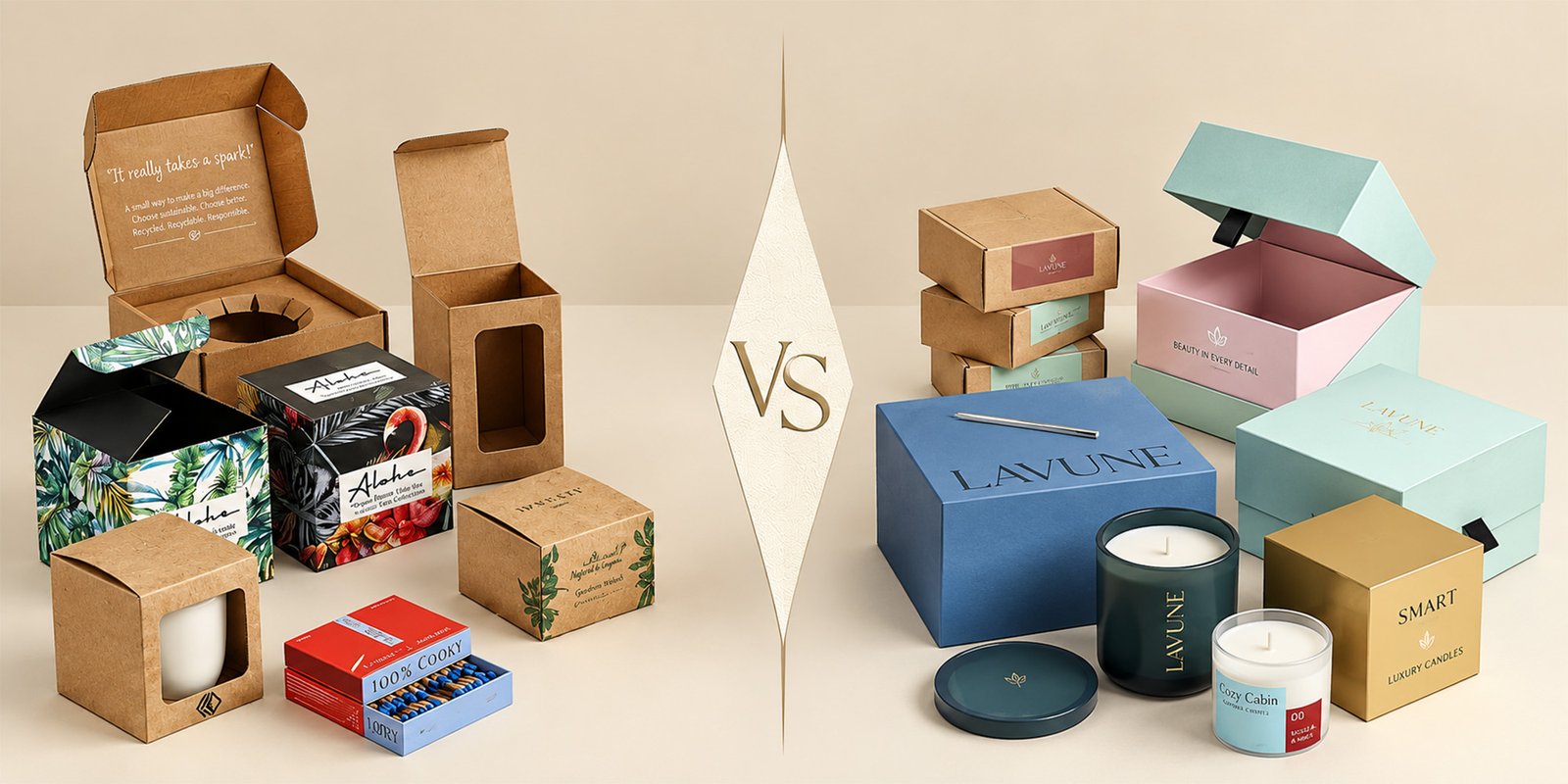
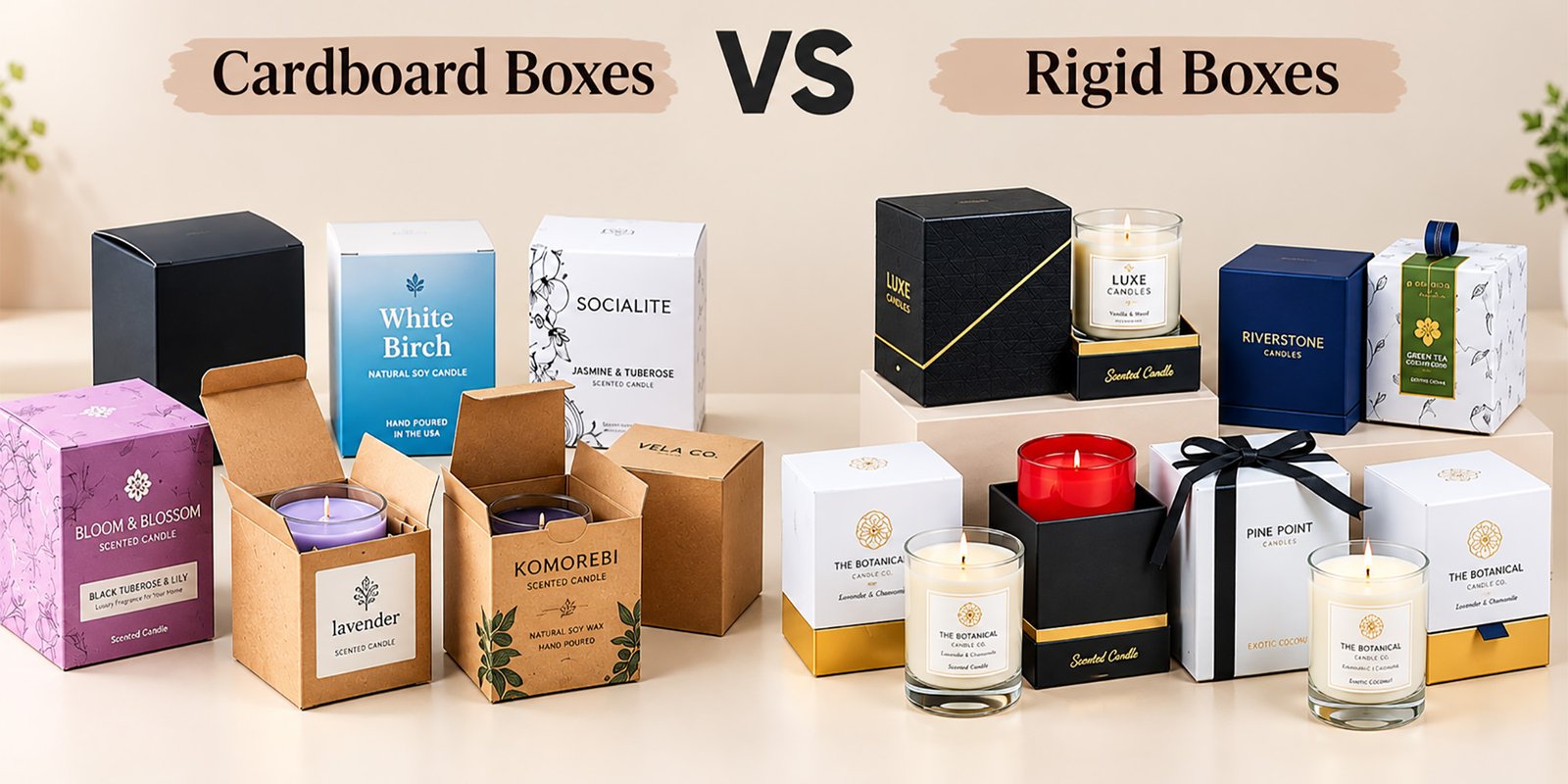
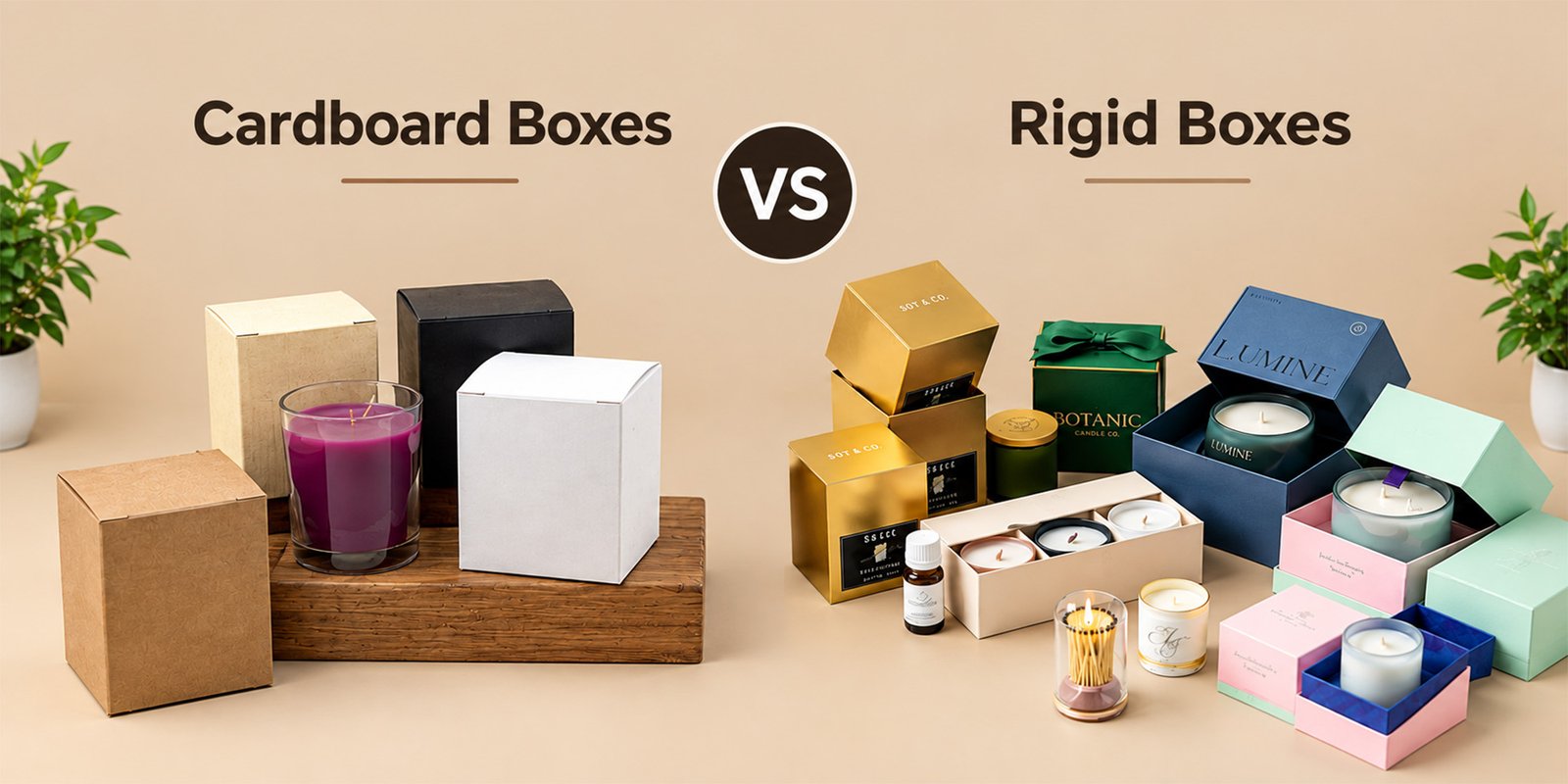
The two aren’t really one material family with different price tags; they’re built differently. A folding carton candle box uses SBS or kraft paperboard, 350–400gsm, thick enough to hold its shape and print well but always foldable flat for storage. A corrugated transport version adds a fluted E-flute layer for cushioning in transport. Rigid candle boxes are a distinct construction entirely: a greyboard or chipboard core, 1.5–2mm (1,200–2,000gsm), covered in printed paper and assembled as a fixed shape rather than folded from a flat blank. That construction contrast, not the printing on top, is what actually drives the price gap.
Kraft or White Board? Getting the Print Surface Right
Kraft board and white-lined chipboard answer different questions, not the cardboard-versus-rigid one, since both formats work with either surface. Kraft suits lighter, single-wick candles and eco-branding, with a natural look most customers recognise straightaway, though it shows moisture marks and scuffs a little sooner than white-lined chipboard. White-lined chipboard works better for bolder, more colourful layouts, because CMYK print holds truer and brighter colour against a white base than against kraft’s brown tone. Neither is the better choice; it comes down to whether the packaging needs a natural, minimal feel or clean, saturated artwork.
Why Jar Weight Decides More Than Brand Preference
A tea light tray weighs around 50 to 100g. A single-wick jar candle comes in around 200 to 350g with the wax and glass together. A three-wick jar in a heavier glass vessel can run from 500g to well over 1kg. That range matters because the box isn’t just decoration; it’s what stops the heaviest item in most candle ranges from cracking itself in a courier van.
If what’s going inside is light enough to lift with two fingers, folding carton stock at 350–400gsm rarely fails. Once you’re holding a jar with both hands, the calculation changes, and board specification stops being optional.
When Cardboard Is Genuinely Enough
- Votives, tins, and single-wick jars under approximately 250g rarely stress a 350–400gsm folding carton, even with a printed finish and foil detail
- Products are packed inside their own courier-facing outer box or mailer, since a Custom Corrugated Boxes UK shipper is already doing the heavy protective work, freeing the inner box to focus purely on presentation
- Subscription and multi-pack formats where the box gets opened once at home instead of being handled repeatedly on a shop floor
- High-volume runs, since folding carton candle boxes typically run £0.38 to £0.95 per unit in the UK, a gap from rigid that only widens as order size grows
Cardboard’s ceiling is roughly where jar weight and shelf handling both stay low. Push past either one, and it starts showing.
When Rigid Actually Earns Its Cost Back
- Heavier multi-wick jars and glass vessels, where 1.5–2mm rigid board resists the corner and base stress a folded carton can’t
- Retail-shelf and gifting ranges, where the box gets picked up, opened, and often kept, so the weight and snap of a lid genuinely change how premium the product feels
- Price points above roughly £12–£15, where the box’s own material cost stops being a rounding error against the margin
- Seasonal or flagship SKUs carrying a brand’s most visible launch, where a folding carton simply reads as cheaper next to the rest of a premium range
Why the Feel in Your Hand Isn’t Just Marketing
This is the part that’s easy to dismiss as fluff but shows up in real return-rate data. A 2023 DS Smith survey found 58% of UK online shoppers said they’d stop ordering from a brand after repeated damaged deliveries – and the reverse holds too: weight and resistance on opening read as quality before a customer has read a single word of copy. A rigid lid’s soft, cushioned resistance signals “this cost something to make” in a way a folded carton flap can’t match, no matter how good the printing is. That’s also why unboxing content plays out differently across the two formats: a magnetic-closure rigid box gives a satisfying click and a slower reveal on camera, while a folding carton opens fast and flat – fine for a quick product shot, but it rarely carries the same social moment.
One 2026 cost wrinkle worth knowing before switching a whole range to rigid: from 2027, UK pEPR’s Recyclability Assessment Methodology (RAM 2027) starts treating some composite, multi-material board constructions less favourably than mono-material folding carton – a laminated or heavily composite rigid build is the kind of construction that risks an amber rather than green rating, which can push modulated fees higher than an equivalent folding carton. It’s not a reason to avoid rigid, but it’s worth checking with Custom Packaging MOQ Explained UK or your supplier before assuming rigid is cost-neutral once fees are factored in. More on that below.
Rigid pays for itself when the box does selling work, not just holding-together work.
Windows, Inserts, and Multi-Candle Sets
Do You Need a Window?
Not always. A window works well when the jar itself, the label, or the wax colour is part of what sells the product, letting it do its own visual work on the shelf. If the branding relies more on the printed box design than on the candle’s appearance, a fully printed box without a window usually gives more usable design surface instead – a choice that applies equally to folding carton and rigid formats.
Do Multi-Jar Sets Need Dividers?
Generally, yes, once more than one jar shares a box. Glass and ceramic vessels knocking together in transit is one of the most common causes of chipped rims and scratched finishes in gift-set candle ranges. A corrugated divider insert or a die-cut cardboard partition keeps jars apart and stops them from passing shock into each other, and this applies whether the outer is a folding carton or rigid, since the divider does a different job from the box wall.
Which Recycles More Easily?
This is where the 2027 pEPR angle mentioned above deserves its own look, since it’s genuinely changed the cost maths rather than just the messaging. A standard folding carton candle box is close to mono-material – plain paperboard with print and maybe a thin varnish – which tends to rate green under RAM because kerbside paper recycling streams handle it cleanly. A rigid box is a composite by construction: a greyboard core wrapped and glued in printed paper, sometimes with a laminate finish on top. That layered build is exactly the kind of construction RAM 2027 treats more cautiously from 2027 onward, since composite materials are harder for recycling facilities to separate cleanly than a mono-material carton.
This doesn’t make the rigid the wrong choice, but it does mean the “which recycles better” question has a real answer now, not just a general assumption that thicker board is somehow less sustainable. Two practical levers worth asking a supplier about if it matters to your range: water-based adhesives over solvent-based ones, and a mono-material paper wrap over a laminated film finish, both of which can help a rigid construction sit closer to green.
The Real Cost Difference in 2026
The gap between formats isn’t flat; it moves with both board weight and finish. This is roughly how it breaks down across the specs most candle brands actually order:
| Board spec | Specific use case | Approx. cost impact |
| Folding carton, 350–400gsm | Tea lights, single-wick jars, mailer-packed SKUs | £0.38–£0.95 per unit (baseline) |
| Folding carton, 400–450gsm + premium finish | Mid-tier gifting, closing the visual gap without going rigid | Around +£0.15–£0.35 per unit over baseline |
| Rigid, 1,500gsm | Entry-level rigid, smaller brands testing the format | Around 3–5x the folding carton baseline |
| Rigid, 2,000gsm (UK standard) | Flagship and gifting ranges | +£1.00–£1.50 per box over the 1,500gsm rigid spec |
| Rigid, 2,400gsm | Ultra-premium ranges, £80+ retail | +£1.40–£2.00 per box over the 2,000gsm spec |
For most cardboard candle boxes, UK brands sell for under £1; even the smaller end of that rigid gap can be the entire margin on the box. For one, retailing at £35 in a gift range, it’s a rounding error against the price tag.
How to Test Before You Commit a Whole Range
Switching the board spec mid-production, after tooling and a print run are already committed, is expensive and slow. Testing properly before that point is rare.
- Order samples in both formats before committing to tooling on either one, rather than deciding from a supplier’s photos or a competitor’s box alone
- Run a real shipping-route drop test, using your actual courier and packing method, not just a desk-height drop, since transit stress varies a lot between a local van run and a multi-depot network
- Check the price-point math directly: divide the box’s unit cost by the product’s wholesale or retail price to see what percentage of the sale the packaging is actually consuming
- Ask what RAM rating the specific construction gets before scaling a rigid range, since the amber-versus-green question above can shift the real cost once pEPR fees are added in
Most growing candle brands don’t neatly graduate from cardboard to rigid as they scale. They end up running both permanently, split by SKU price point and jar weight rather than by how established the brand has become – usually the more profitable way to run a multi-line range anyway.
Production Time Differs Too, Not Just Price
Lead time rarely makes the shortlist of reasons brands pick one format over the other, but it should, especially heading into a seasonal launch. Folding carton candle boxes typically run 7–10 working days from approved artwork, since the process is largely die-cutting and folding a printed flat sheet. Rigid boxes take longer, commonly 10–20 working days post-approval, because the greyboard core has to be wrapped and assembled as a fixed shape rather than folded on a production line at the same speed. If a rigid gift range is planned for a specific launch date, particularly around Christmas or Valentine’s, building in that extra week or two at the planning stage matters as much as the material decision itself.
Two Brands, Two Wrong Turns
A tea light multi-pack brand switched its whole range to rigid boxes, chasing a shelf-ready look, including the £4 six-pack line. The box cost alone ate most of that product’s margin, and the range was quietly discontinued within two quarters. Reverting the tea light SKUs to a printed folding carton with a foil-stamped logo kept most of the shelf appeal at a fraction of the cost, while the brand’s actual flagship jar range stayed in rigid, where the spend made sense.
A three-wick jar candle brand went the other way, running its entire catalogue on a standard 300gsm folding carton to keep unit costs down. Corners split and jars occasionally cracked once orders started shipping through multi-depot courier networks rather than local delivery. The fix wasn’t a full switch to rigid; it was adding an E-flute corrugated shipper around the existing folding carton for transport, while retaining the lighter box for the in-store, hand-carried version of the same product. Same jar, two separate journeys, two separate box formats.
Questions Worth Asking Before You Choose
Does a heavier jar always require a rigid board? Not necessarily. A heavy jar shipped in its own protective outer box can often stay in a folding carton, since the outer box absorbs the transit stress. It’s shelf handling and repeated opening, not weight alone, that push the case for rigid.
Can I run a mixed range, rigid for some SKUs and cardboard for others? Yes, and it’s often the smarter move. Matching board spec to each SKU’s price point and weight, rather than picking one material for the whole range, is usually what protects margin on the cheaper lines without cheapening the flagship ones.
Is there a middle option between plain cardboard and full rigid? A folding carton with a heavier board weight (400–450gsm) and a premium finish such as soft-touch lamination or spot UV can close a lot of the visual gap at a fraction of rigid’s cost, worth testing before committing a whole range to rigid tooling.
Does the kraft-versus-white board choice affect whether I should go rigid? No, they’re separate decisions. Both kraft and white-lined board are available in folding carton and rigid formats, so pick the print surface based on branding and pick the construction based on jar weight and sales channel.
Do multi-jar gift sets need to be rigid, or can cardboard work with the right insert? Cardboard with a well-fitted corrugated or die-cut divider often works fine for multi-jar sets, provided the total set weight stays reasonable. Rigid becomes worth it once the set itself is being positioned and priced as a premium gift rather than a standard multi-pack.
How much time does testing samples in both formats actually add? Usually, a few days at the quote and sampling stage – minor set against the cost and delay of discovering a board spec is wrong after a full print run has already been committed.
Conclusion
The cardboard-versus-rigid decision for candles isn’t really about which material is “better.” It’s about matching board weight to jar weight and box job to sales channel, then letting price point decide whether the extra spend on rigid actually gets seen or just gets paid for. A £4 tea light doesn’t need a box that costs more than the product inside it, and a £35 three-wick jar sitting in a gift range shouldn’t be undersold by a folding carton that reads as an afterthought next to it.
The brands that get this right rarely settle it once and move on. They revisit the split as the range grows: a new SKU at a new price point, a courier route that changes how rough transit honestly is, or a pEPR rating that turns the maths on a construction that used to make sense. Treating the choice as a per-SKU decision, reviewed again whenever something about the product or the supply chain changes, tends to protect margin far better than picking one material for the brand and staying loyal to it out of habit.
Hale Path Packaging builds both formats, from folding carton Candle Cardboard Boxes through to full Custom Candle Boxes in rigid board, with our candle packaging advisors happy to spec a mixed range rather than defaulting you to one material across the board. MOQs start at 100 units, with a standard turnaround of 7–14 working days from artwork sign-off, so testing both formats side by side before committing to a full range doesn’t mean a long wait either way.
Written by the Hale Path Packaging team

Harry Taylor
Packaging expert at Hale Path Packaging, sharing insights on custom packaging solutions, sustainable materials, and industry trends.