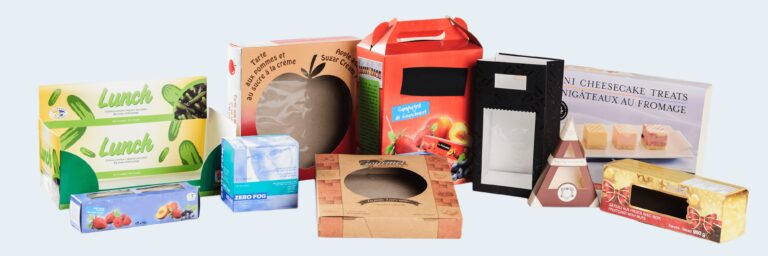
Why Are Retailers Choosing Corrugated Display Boxes UK for Product Presentation?
Corrugated display boxes do three jobs in one: they ship the stock, open into a ready-made display, and carry the brand’s print on the shelf or counter. Retailers favour them because they cut stocking time, but getting the result right depends on the tear-off perforation, the flute choice, and sizing the tray to the actual shelf before artwork is signed off.
Why do so many shops now ask for corrugated display boxes UK suppliers make? Because one box covers three jobs. It protects the stock in transit. On arrival it opens into a display that’s ready for the counter or shelf. Nobody on the shop floor has to spend time unpacking and arranging stock item by item. The brand gets its printed presentation and the shop gets neat shelves in less time. This guide explains how these boxes work and why they are winning shelf space.
In this article:
- How retail-ready packaging boxes work and which formats exist
- The pressures pushing retailers towards corrugated displays
- How to brief a display box so it performs on the shop floor
What Are Corrugated Display Boxes and How Do They Work?
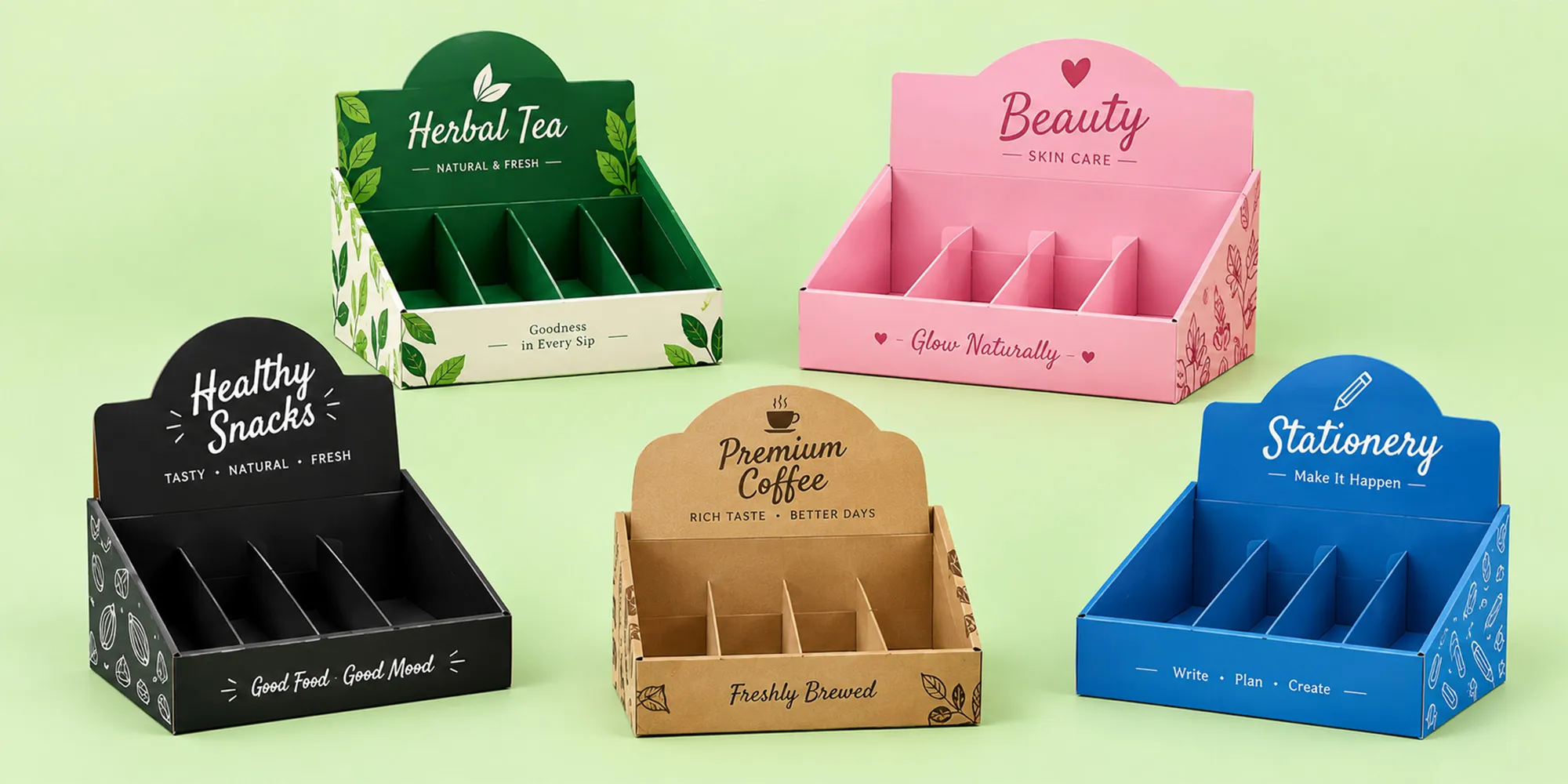
A corrugated display box is a printed cardboard carton built to ship product and then sell it. The top or front panel tears away along perforations. What’s left is the base, which stays on the counter or shelf with the product already facing the shopper.
Industry bodies group these formats under retail-ready packaging. IGD, the UK grocery research body, splits them into types. Shelf-ready packs are corrugated trays full of primary packs. Display-ready units are freestanding stands, often at aisle ends. Replenishment-ready bands bundle packs into one unit until staff remove them.
Which Formats Are Used Most in Shops?
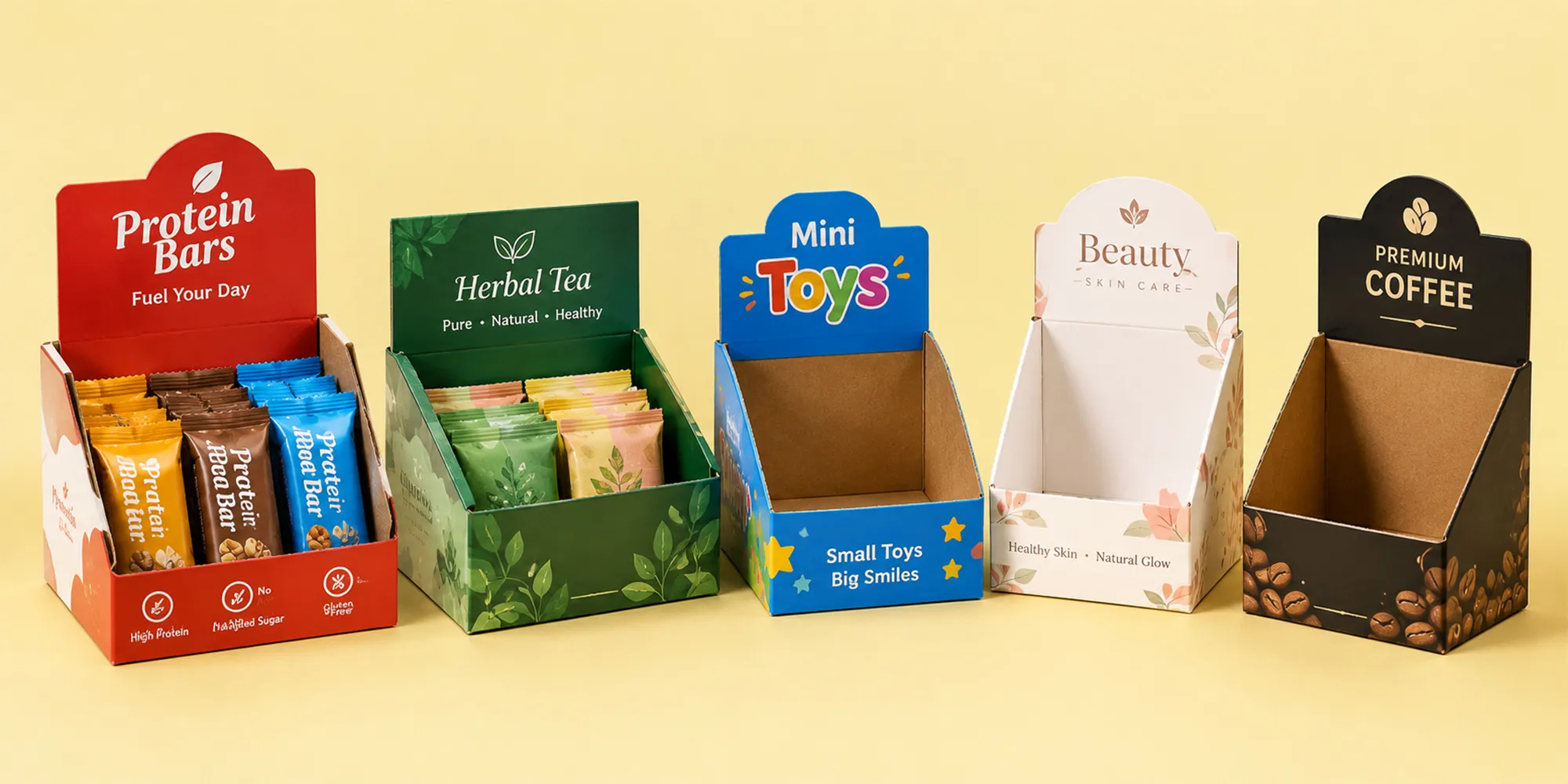
- Counter display boxes go next to the till, and they’re good for small, cheap impulse buys.
- PDQ trays, which stand for pretty darn quick, show up already filled and can be put straight onto a shelf.
- Dump bins and floor-standing units are used for loose stock in promotions out on the shop floor.
Does Flute Choice Change the Display?
It does. Strength and print quality both come down to how thick the board is. E-flute is about 1.5mm to 2mm thick and prints smoothly, so you’ll usually find it on counter and shelf trays. For heavier floor units, B-flute is the usual pick because at nearly 3mm it carries more weight. Flute profile and ECT rating decide how a display copes with stacking -our guide to single wall vs double wall corrugated boxes covers how wall construction changes that further.
Pressure One: Staff Time at the Shelf
Corrugated displays cut stocking time. With a tear-off tray, one person can put a whole row of product on the shelf in one go. Without it, staff unpack and arrange units one by one.
In supplier research reported by trade press such as The Grocer, labour efficiency at the shelf is consistently cited as the single biggest reason retailers push for retail-ready packaging, ahead of concerns like on-shelf availability. I wasn’t able to independently confirm the specific percentages in the original draft (75%/66%), so I’ve kept the claim qualitative rather than publish figures I couldn’t verify against a primary source -see the flag below if you have the original survey to cite.
The detail that decides this is the tear-off perforation. A clean tear opens in one pull. When a tear line sticks and someone ends up cutting it with a knife, all the time you hoped to save disappears. Shelf and counter depth also get measured against the display size before we sign off the artwork. The point is a tray that sits flush once it’s opened.
When Shelves Vary Between Retailers
Shelf sizes vary between chains, and that frustrates display design. Variation in shelf and fixture sizing is one of the most commonly reported headaches among UK display suppliers. Our advice is simple. Get fixture dimensions from each retailer and size the display for the narrowest shelf. It’ll still work on a wider one. A wider tray fits only some.
Pressure Two: A Shelf That Looks Full, Branded and Simple to Shop
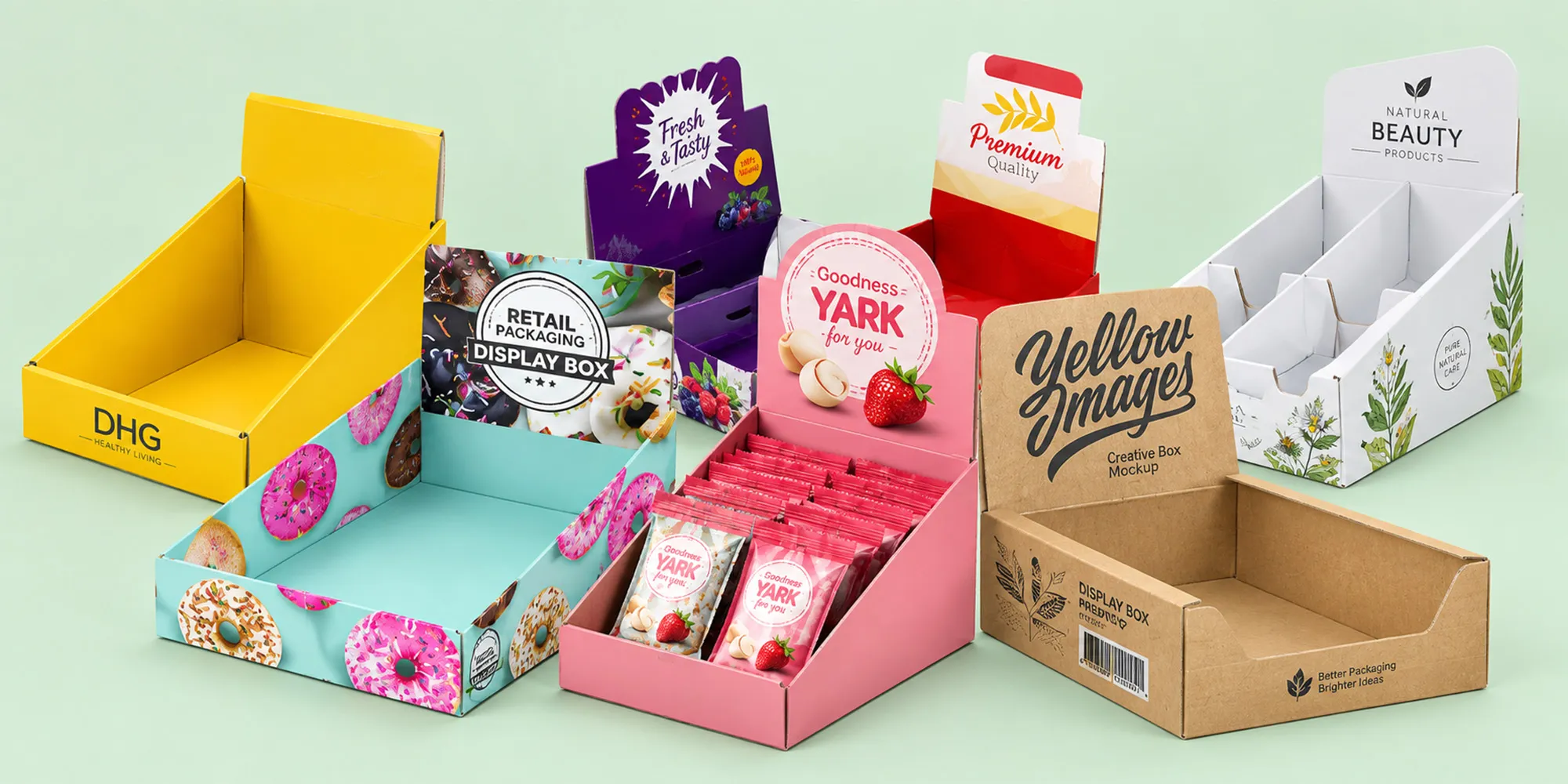
Aisles are busy places, and a corrugated display gives your brand a little territory of its own. The printed header, side panels and product window make the sale when there’s no assistant around to help.
Print quality matters here. Corrugated takes flexo, digital or offset printing without trouble. To pick out a logo or other detail, you can add a matt or gloss coating, spot UV or foil. White board gives brighter colour. Kraft board has an earthy, natural look that works for food, wellness and craft lines. To see how each print method behaves on the board, read our guide to how custom printed corrugated boxes are made.
Kraft Board vs White Board for Print
Colours look brighter and photos crisper on white board, since white bounces light back. Kraft is browner and absorbs more ink, which warms the colours and softens them slightly. Neither one wins outright. Pick kraft for a craft, organic or earthy brand and white for bold, high-contrast artwork. Whatever you pick, see a sample of your artwork on the real board before the full run.
Product Facing and Why It Matters
Presentation also depends on which way the product faces. When the tray is cut well, each item leans forward, and shoppers can read the label easily. When it’s too deep, the front row gets lost. Before anything goes to print, we test the product in a mock-up, so we know it sits firmly without leaning or rattling.
Take a small skincare brand’s lip balms sitting in a counter tray. In the first design, they lie flat, and shoppers see nothing but caps. A forward-tilted insert shows the printed labels instead. Only the angle changed.
Pressure Three: Can the Display Survive Transit?
If a display arrives damaged, it won’t sell anything. It gets put on pallets, piled up, and now and then stored somewhere humid before it reaches the shelf. Crushed corners mean rejected stock.
Strength comes from board grade, flute, and construction. ECT, or edge crush test, measures how well board resists stacking pressure. Our post on how much weight a cardboard box can hold explains how ECT and box compression relate.
Every perforation and window takes some board out, so the carton can take less load. A heavier flute, a stronger liner or reinforced corners put some of that strength back. If that’s skipped, even a lovely display can arrive crushed. If the units inside the tray also need their own protection in transit -bottles, jars or anything that can knock together -our guide to void fill options for corrugated boxes covers bracing products inside a box before they ever reach the shelf.
Corrugated vs Rigid vs Plastic Displays
Corrugated wins when it comes to weight, cost and recycling. Rigid and plastic displays do better on durability and finish. How long the display will be in store usually settles it.
| Feature | Corrugated display | Rigid board display | Plastic or acrylic display |
| Typical lifespan | Short to medium promotion | Long-term or premium | Long-term |
| Print and finish | Good, with coatings | Premium, tactile | Limited, often labels |
| Weight | Light | Heavier | Heavier |
| Recycling | Easy to recycle | Lamination makes it harder | Depends on the plastic used |
| Works best for | Quick promotions and impulse lines | Luxury gift sets | Displays that stay for years |
Use this table to get started, not as a final answer. A well-made corrugated unit, stocked carefully, can sometimes last a full season.
Who Bears the Cost?
Retailers get most of the gain from shelf-ready packaging, and it’s frequently the brand that pays more. A study by MIT logistics researchers covered six US retail channels. Retailers needed less labour for replenishment, the researchers found, but product makers had higher costs. Whether the trade was worthwhile came down to a few factors. These were how fast items sell, inventory carrying costs, how many SKUs sit on a shelf and the store’s own replenishment routine.
UK suppliers report the same concerns: supply chain cost, a lack of standardisation across retailers, and shelf sizes that differ chain to chain. That is why brands should judge cost per unit sold, not cost per box.
Four things drive display pricing:
- Board grade and flute
- Print coverage and finishes
- Die tooling for the tray shape
- Order quantity
Fast sellers justify a printed display most easily, because the quicker a product turns, the sooner the display repays its cost. Slow lines may fare better in a simpler tray.
Corrugated Display Boxes and Recycling
Recycling is built into the design of corrugated board, and UK household and trade collections generally take cardboard. That helps retailers who want display packaging to leave the store without a landfill problem.
Add-ons change the picture. Heavy lamination, plastic windows and inserts made of several materials can all make recycling harder. Keeping a display mostly board makes disposal simpler. Packaging producers also face reporting and fee duties under UK extended producer responsibility -our guide to UK packaging tax and EPR rules covers who’s affected.
Best Uses for Corrugated Displays
The sweet spot is anything bought on impulse or sold on promotion. Counter trays hold confectionery, lip balm, supplements and small accessories. Shelf trays are for packaged food and household goods. Seasonal or promotional stock is what dump bins and floor units are for.
They suit fewer premium items. Premium products such as a boxed fragrance or gift set tend to need a rigid, tactile finish that corrugated just can’t offer. Retail cardboard boxes or rigid formats do those products more justice. How the product sells should decide which format you go for.
Planning Display Orders Around a Promotion
Begin with the date the display must be in store, then work out the schedule from there. Artwork has to be approved, the boxes have to be made, and they have to reach the retailer’s distribution centre, and each step takes time. A lot of retailers also fix their own delivery windows, so it’s worth checking those early. Christmas and Easter lines are the tightest. Order with a buffer. A late display is worth nothing once the promotion has started.
What Mistakes Make Display Boxes Underperform?
Most display problems start with the brief.
- Guessing dimensions. A tray cut to estimated sizes either rattles or squeezes the product.
- Ignoring the perforation. A tear line across a printed logo splits the brand in half.
- Overfilling. Too many units strain the base and the tear-off panel.
- Skipping the mock-up. Flat artwork hides how folds will land on a real structure.
- Choosing a display when a shipper will do. A plain printed shipper may cost less and do the job just as well for a slow line in a store that restocks from the stockroom.
Some products just don’t need a display. You get your money’s worth when it saves stocking time or helps the product look better.
What a Display Box Brief Should Cover
Getting the brief right at the start saves you from redesigning later. Our cardboard counter display boxes quotes start from a few facts.
- Product size and weight: one unit’s size and weight.
- Units per display: tray capacity, in products.
- Placement: counter, shelf, floor or promo bay, with the space limits.
- Board and flute: wall type (single or double) and board colour.
- Print and finish: your colour scheme and any special finishes.
- Quantity and timing: order size and in-store date.
Do you have the retailer’s shelf or counter measurements? Please send them with the brief. Standard shelf sizes vary, and a tray that fits one chain may not fit another. For wider board options, see our overview of corrugated packaging.
Frequently Asked Questions
Are shelf-ready boxes and display boxes different things? They are. A shelf-ready box is turned into a tray once it’s on the shelf. A display box stands on a counter or floor as its own unit.
Are PDQ boxes the same as corrugated display boxes? PDQ trays are one type of corrugated display. They arrive pre-filled and need minimal setup.
Can a display box be printed in small runs? Digital printing suits shorter runs. Offset and flexo usually suit larger ones.
Does perforation weaken the box? Yes, slightly. Designers offset it with stronger board or reinforced corners.
Single wall or double wall for a display? Single wall suits light counter trays. Double wall suits heavier floor units.
How do I check the fit before ordering? Put your actual product in a mock-up tray. Approve the print files once you’ve done that.
Can one display hold different flavours or sizes? Yes, if the tray has dividers or is sized for each SKU. Send the SKU list along with your quote request.
Does the retailer have to approve the display before it’s printed? Quite often, yes, since many retailers have their own display specifications. Confirm this before you finalise the artwork.
Conclusion
There’s nothing mysterious about why retailers choose corrugated display boxes UK-wide. Stocking is quicker, product arrives in good condition, and a brand gets a space of its own on the shelf or counter. But those gains depend on small details. Get the tear-off clean, the flute right, the tray sized to the real shelf and the finish suited to the board, and the box shape matters far less.
A display is a better fit for some lines than others. Fast-moving and promotional products pay it back quickly, while slow ones may be better off with a simpler shipper. Look at the cost per unit sold before you commit.
When you’re ready, collect your product dimensions, the units per tray and where the display will go, and send us a quote request using the brief above.
Hale Path Packaging makes corrugated display boxes and cardboard display packaging in single and double wall board, built around your product. Orders start from 100 units and turnaround is 7 to 14 working days.
Written by the Hale Path Packaging team, packaging specialists with 10 years of experience supplying corrugated, rigid and custom packaging to start-ups and established brands across the UK.

Harry Taylor
Packaging expert at Hale Path Packaging, sharing insights on custom packaging solutions, sustainable materials, and industry trends.