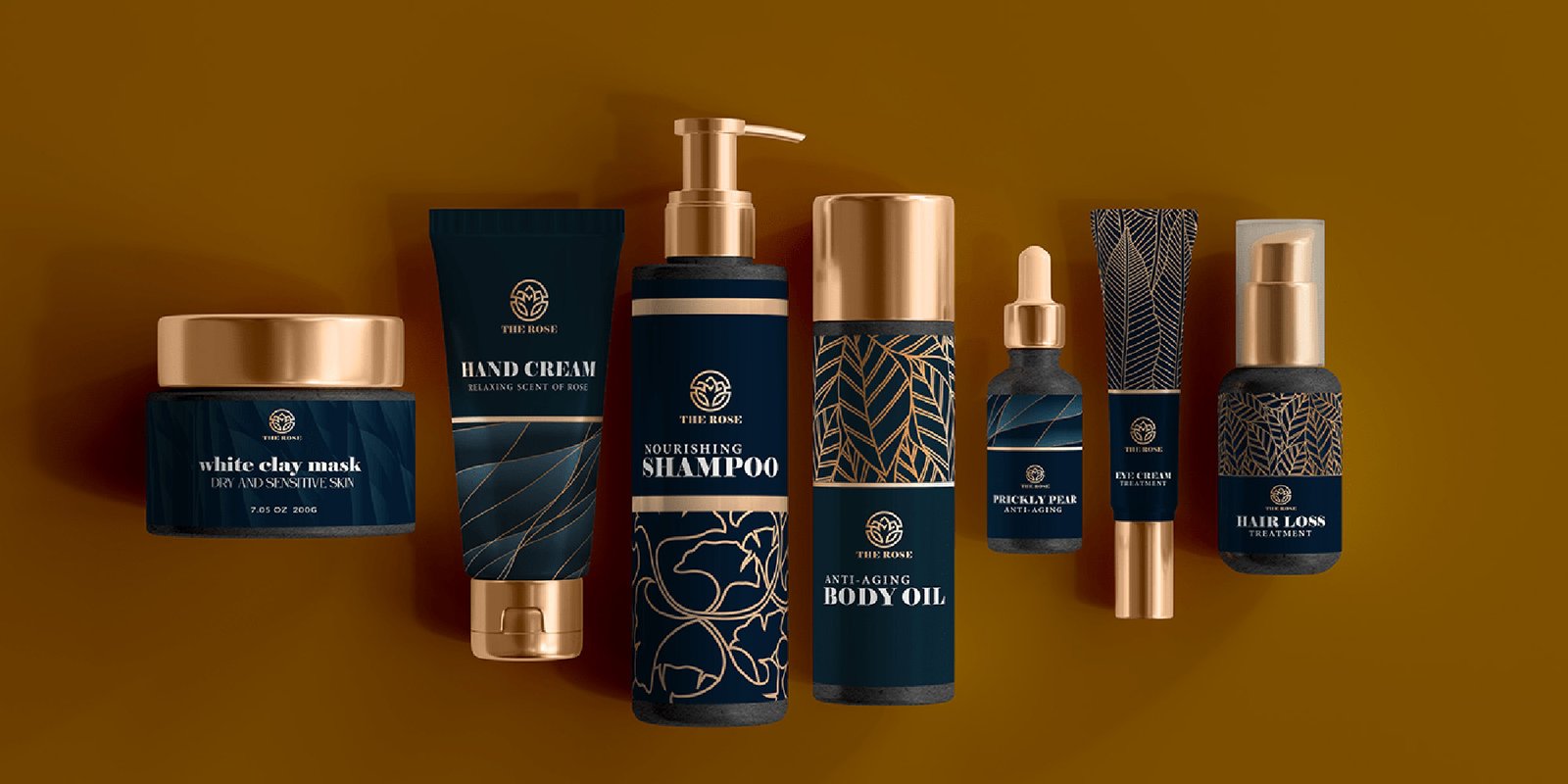
UK Extended Producer Responsibility (EPR) now charges cosmetic brands a disposal fee per tonne of packaging, and the rate depends on material – from £192/tonne for glass up to £461/tonne for hard-to-recycle fibre composites. Plastic, still the most common cosmetic packaging UK material, sits at £423/tonne – more than double paper and card at £196/tonne. Combine that with real MOQ pricing (1,000+ units for standard cartons, 5,000+ for aluminium components), UK labelling rules, and the lead-time gap versus overseas suppliers, and material choice is now a cost decision as much as a design one. This guide walks through the sourced numbers for each.
Most cosmetic brands still price a box on unit cost, print finish and lead time, and miss the number that changed for 2026: UK EPR now bills packaging by material recyclability, so the packaging cost you budgeted last year is very likely already out of date. Add in cosmetic labelling rules most suppliers never mention, and MOQ math that competitor pages describe as \”a barrier\” without ever quantifying it, and most custom cosmetic packaging buyers in the UK are working from half the real cost picture.
This guide draws on Hale Path Packaging’s direct manufacturing experience across custom cosmetic boxes, custom eyeshadow boxes, custom lipstick boxes and branded cosmetic packaging to provide a sourced 2026 cost and compliance roadmap.

1. The 2026 UK EPR Cost Gap: Why Material Choice Now Dictates Your Margin
Extended Producer Responsibility (EPR) is no longer a policy discussion; it’s a line item on your invoice. Since October 2025, cosmetic brands crossing the £1m turnover and 25-tonne thresholds have been liable for disposal fees.
2026 Illustrative Fee Comparison by Material
Source: PackUK illustrative 2026-27 Year 2 fees and DEFRA scheme updates.
| Material Type | Base Fee (per tonne) | RAM Banding Impact |
| Paper & Cardboard | £196 | Green (highly recyclable) |
| Glass | £192 | Neutral |
| Aluminium | £245 | Neutral (mono-material) |
| Plastic (Polymer) | £423 | Red surcharge (~1.2x multiplier) |
| Fibre Composites | £461 | Red surcharge (hard to separate) |
For a cosmetic brand moving 30 tonnes of packaging a year, the gap between a paper-based strategy and a plastic-heavy one is over £6,800 in disposal fees alone, before you factor in the Recyclability Assessment Methodology (RAM) surcharges that push plastic even higher. Source: ERP UK 2026 compliance summary.
How to Use This Data:
- Audit your secondary packaging. If you’re using plastic inserts inside a cardboard box, the whole unit may be assessed as a composite, pushing you into the £461/tonne band. Swapping to cardboard inserts keeps you in the £196/tonne band.
- Consider mono-materials. A plastic bottle with a different plastic cap and a foil seal is harder to recycle (and thus more expensive under EPR) than a mono-material aluminium tin.
2. Custom Cosmetic Packaging MOQs: The Real Math Behind \”Low Order Quantities\”
UK cosmetic brands often struggle with MOQs (Minimum Order Quantities) because most suppliers quote based on offset or flexographic printing, which requires high setup costs. Source: BPIF (British Printing Industries Federation) 2026 state of the industry report.
Typical 2026 MOQ Bands for UK Cosmetic Brands
| Format | Low MOQ (Digital) | Standard MOQ (Offset) |
| Folding Cartons (Boxes) | 100 – 250 units | 1,000+ units |
| Rigid Luxury Boxes | 50 – 100 units | 500+ units |
| Aluminium Tins/Bottles | N/A (Stock + Label) | 5,000+ units (Custom) |
| Glass Jars/Bottles | N/A (Stock + Label) | 10,000+ units (Custom) |
What is the most cost-effective MOQ for a new UK cosmetic brand? For most startups, the 500-unit band is the \”sweet spot.\” It’s high enough to trigger a meaningful drop in unit price versus a 100-unit sample run, but low enough to avoid tying up thousands of pounds in stock before you’ve proven the product’s sales velocity.
3. UK Cosmetic Labelling Rules: The Compliance Checklist Most Brands Miss
In the UK, cosmetic packaging isn’t just a marketing canvas; it’s a legal document. Since Brexit, the UK has its own Cosmetic Regulation (Schedule 34 of the Product Safety and Metrology etc. Amendment etc. EU Exit Regulations 2019). Source: Office for Product Safety and Standards (OPSS).
Mandatory Elements for UK Cosmetic Packaging:
- UK Responsible Person (RP): You must list the name and UK address of the Responsible Person. An EU address alone is no longer compliant for the UK market.
- Country of Origin: If the product is made outside the UK, you must state the country of origin (e.g., \”Made in France\”).
- Nominal Content: The weight or volume at the time of packaging (e.g., 50ml e).
- PAO (Period After Opening): The open-jar symbol with the number of months the product is safe to use after opening (e.g., 12M).
- Batch Code: A reference to identify the manufacture of the product.
- Ingredients List: Must use INCI (International Nomenclature of Cosmetic Ingredients) names, preceded by the word \”Ingredients.\”
Small units under 5g or 5ml, including free samples, can skip the nominal content declaration. Where full labelling genuinely can’t fit on a small unit, the detail can move to an accompanying leaflet or swing tag, provided the pack carries the \”refer to insert\” open-book symbol pointing to that information. Multipacks and gift sets need either every unit individually labelled, or full compliance carried on the outer box.
Retrofitting a compliance panel onto a design finalised around a logo and colour palette almost always means shrinking artwork space at the worst possible stage. Building the ingredient list, batch code field and PAO symbol into the dieline from the first draft avoids that scramble entirely.
Eco-Friendly Materials That Also Lower Your EPR Bill
Sustainability and EPR cost aren’t separate goals here – they’re the same lever. A material that scores well under RAM directly reduces the effective fee you pay, which means \”eco-friendly\” and \”cheaper to dispose of\” are the same spec decision, not a trade-off.
- kraft paper paperboard typically clears RAM assessment toward the lower end of the fee scale, since certified virgin fibre has an established, high-yield UK recycling stream.
- Recycled kraft board performs even better under RAM in most cases — a lower base rate combined with reduced virgin material sourcing.
- Mono-material aluminium closures, free of mixed coatings or non-separable liners, avoid the higher effective rate that composite metal components attract.
- Water-based or aqueous coatings in place of plastic lamination keep paperboard fully recyclable in a single stream, rather than needing separation before recycling.
- Minimal-layer construction — fewer coatings, fewer bonded materials — is consistently the fastest way to move a format into a lower RAM banding.
Does a \”recyclable\” claim on packaging guarantee a lower EPR fee? Not automatically. RAM assesses actual separability, not just the base material. A heavily laminated paperboard box can land in a higher effective fee band than a plain aluminium tin, because the coating or lining makes it harder to recycle in practice — even though both would be labelled \”paper\” or \”metal\” on the box.
Certified fibre sourcing also isn’t just a shelf claim – it’s documentation you need on file if your EPR reporting is ever queried, since RAM banding assumes the certification is verifiable. Working with a supplier that already holds that paperwork removes one more compliance gap you’d otherwise have to chase down separately.
The Bottom Line for 2026 Cosmetic Packaging UK Decisions
None of this – the real fee gap between plastic and paper, the RAM multiplier that can push a \”recyclable\” box into a higher band, the MOQ math behind \”barrier\” language, the lead-time cost of overseas sourcing, or the labelling panel that has to share space with your logo – is a future problem to plan around. It’s the spec sheet a UK cosmetic packaging brand is working from right now, whether current pricing reflects it or not.
Hale Path Packaging works across paperboard and aluminium formats built toward the lower end of the RAM fee banding from the outset, with UK-based production that closes the lead-time gap covered above, and compliance detail – ingredient panels, batch codes, PAO placement – built into the dieline from the first draft rather than added after. For brands speccing custom cosmetic boxes, custom eyeshadow boxes or custom lipstick boxes for the year ahead, that’s the practical starting point: choose the material with the cost and compliance picture already worked out, not the one that looks cheapest until the EPR invoice arrives.
Get a free custom cosmetic packaging quote, and we’ll walk you through material, MOQ and RAM banding for your specific range.

Harry Taylor
Packaging expert at Hale Path Packaging, sharing insights on custom packaging solutions, sustainable materials, and industry trends.