Quick answer: The right pet food packaging depends on what’s inside. Dry kibble in 1–6 kg bags needs a flat-bottom or quad-seal pouch with a high barrier and a resealable zip. Treats and training packs (250 g–1 kg) work best in stand-up pouches. Samples and single-serve treats suit three-side-seal pouches. Wet food and liquid supplements need spout pouches. Get the format wrong and the food goes stale, the bag splits, or the shelf presence disappears.
The formats that actually work for pet food
- Flat-bottom pouches — dry food, 1–6 kg. The workhorse for retail dry food. They stand straight on the shelf, hold their shape when full, and give you four print panels for branding, feeding guides and nutritional panels. Our pet food packaging range includes flat-bottom options for both dog and cat food, including recyclable dog food flat-bottom pouches in mono-material film.
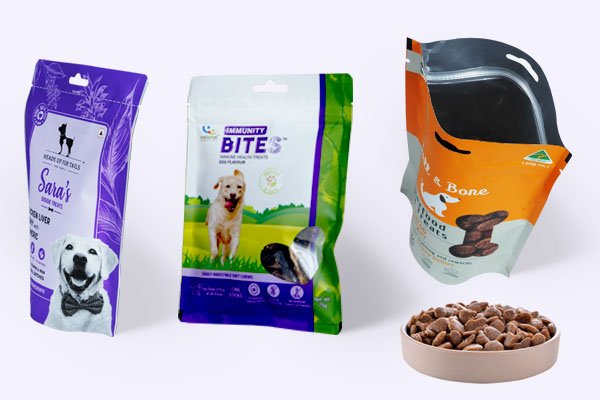
- Stand-up pouches — treats and training packs, 250 g–1 kg. The default for treats. A pocket zip keeps them fresh after opening, and a window panel lets buyers see the product. Dog treat flat-bottom packaging bags are the sturdier version of the same idea — better for heavier fills.
- Quad-seal pouches — heavy fills, 2–5 kg. Four corner seals hold the bag square under a heavy fill, where a stand-up pouch would bulge. Best for bulk dry food and larger retail packs. See quad-seal pet food pouches.
- Three-side-seal pouches — samples, trial packs and single-serve treats. Light, cheap to produce and ideal for training samples, subscription-box inserts and trial sizes. See three-side-seal pet treat pouches.
- Gusset bags — feed, bulk and value packs. Side gussets expand as the bag fills, so they suit larger volumes and wholesale-style packs. See pet food gusset bags.
- Spout pouches — wet food, pastes and liquid supplements. A spout gives controlled pouring and resealing for wet products. Worth considering if you sell wet food, gravies or liquid supplements.
What keeps pet food fresh
Pet food goes stale through the same enemies as human food: oxygen, moisture and light. A good pouch blocks all three. High-barrier laminates (PET/foil/PE or metallised PET/PE) are the standard for dry food with a long shelf life. A resealable zip matters just as much — once a pet owner opens the bag, the zip is what keeps the rest of the food fresh for weeks. For the full picture on shelf life, see our guide on how long Mylar bags keep food fresh with oxygen absorbers.
Labelling space: don’t run out of room
UK pet food packs carry a lot of mandatory information — ingredients and composition, nutritional declaration, feeding guide, target species and life stage, allergens, batch and best-before details. A small pouch with a busy design leaves no room for it. Flat-bottom and quad-seal formats give you the most print area; if your design is illustration-heavy, check the labelling panel fits before you approve the artwork. Your regulatory team owns the wording — the pouch just needs to give it space.
Recyclable options
Recyclable mono-material pouches (PE or PP) are now available for dry pet food and treats, designed for recycling through supermarket collection points — flexible film is not yet collected at the kerbside in most of the UK. If recyclability is part of your brand story, ask for mono-material structures and OPRL labelling. See recyclable pet food packaging and sustainable pet food packaging bags.
What it costs, and what small brands should order
Minimum order is 100 units, production runs 7–12 days, and delivery is free across the UK. For a first run, order the smallest quantity that covers your launch and a few weeks of sales — a pouch that sits in storage for a year is money tied up. Custom print is what makes the pack yours: your artwork, your colours, your feeding guide and your barcode. If you’re still testing the product, plain stock pouches are a cheaper way to trial the format before committing to print.
Checklist before you order
- Match the format to the fill weight — flat bottom or quad seal over 2 kg, stand-up under 1 kg, three-side-seal for samples.
- Confirm the barrier suits your shelf-life claim.
- Check the resealable closure survives repeated opening.
- Leave room on the artwork for the full labelling panel.
- Decide on recyclable mono-material or standard laminate before the quote.
- Order a sample pouch first and fill it with your actual product.
FAQ
What is the best packaging for dry dog food?
A flat-bottom or quad-seal pouch with a high-barrier laminate and a resealable zip, sized 1–6 kg. It stands on the shelf, protects against oxygen and moisture, and reseals after opening.
Are pet food pouches recyclable in the UK?
Mono-material PE or PP pouches are designed for recycling and are collected at large supermarket collection points. Mixed-material laminates are not currently recyclable at kerbside.
What is the minimum order for custom pet food pouches?
100 units, with production in 7–12 days and free UK delivery.
Can I get a sample before ordering?
Yes — order a sample pouch first and test it with your actual product before committing to a full print run.

Harry Taylor
Packaging expert at Hale Path Packaging, sharing insights on custom packaging solutions, sustainable materials, and industry trends.