Void Fill Options for Corrugated Boxes UK: What Actually Works
void fill for corrugated boxes fill has one job -keep the product still inside the box. Light products (under 500g) need only paper or small air pillows. From 500g to 2kg, wrap the product first, then pack paper or air pillows around it. From 2kg upward, loose fill isn’t enough -you need fitted corrugated inserts, foam, or bracing built around the product’s shape. A simple shake test tells you which one you actually need.
Void fill for cardboard boxes has one job. Keep the product still. You can choose from paper, air pillows, bubble wrap and corrugated inserts, and they don’t all behave the same in a box. It helps to ask yourself two questions first. How heavy is the product? And how easily does its surface get marked or dented?
Many damaged parcels arrive in a perfectly sound box. The product slid about inside, knocked the walls and broke. Each bump only shifts it a little. The trouble is that a parcel gets knocked about a fair bit between the warehouse and the doorstep, and all those little shifts add up. So the filler deserves as much thought as the board. Go too soft, and the product keeps moving around. Go too hard, and the flaps bulge and the seams start to strain.
This guide walks you through the choice by product weight, anything from under 500g to over 10kg. We begin with a simple shake test. Then we compare the main protective packaging fillers used in the UK, and what happens to each one when the parcel arrives and gets recycled.
In this article:
- A simple shake test to find out how much filling a box needs
- The protective packaging fillers that suit each weight, from under 500g to over 10kg
- How the main fillers compare, including what happens to them after delivery in the UK
What void fill for corrugated boxes does inside a Corrugated Box
The gap between your product and the box walls is what void fill is for. If nothing’s in there, the product can slide, spin and knock the sides every time someone lifts or moves the parcel. A lot of damage in transit starts with that movement. In logistics, void fill and other loose protective materials are grouped under the word dunnage.
On void fill vs cushioning, the two do different jobs. Void fill holds the product in place. Cushioning absorbs a knock. Bubble wrap does both. Loose crumpled paper mainly fills space. Work out which job your product needs done, and choosing gets a lot simpler.
The box itself matters too. The walls take the hit from outside, and the filler keeps the product away from them. Every box also loses a little room to its own walls. B-flute board is about 3mm thick. Say a box measures 300mm along the outside. Inside, you’ve got roughly 294mm. So when you’re working out the gap, measure the inside.
If you want more detail on internal and external sizes, our guide on how to measure a box for shipping covers it.
Try a Shake Test Before You Buy Any Filler
A shake test tells you whether the box has enough void fill and whether the filler is really holding the product. You’ll need a minute, and it won’t cost you a penny.
- Pack the box as if it were going out, with the filler you’re considering, and shut it.
- Give it a gentle shake from side to side, and then up and down.
- Put it down on each face one after another, and listen out for any knocking.
Feel or hear anything move? Use more filler, or a firmer type. See the flaps bulging, or a lid that won’t lie flat? That’s too much filler.
Loose paper gets squashed quickly, so do the test again once the box has been sitting under pressure or stacked up for a bit. A filler that passes at first and fails later isn’t holding the product firmly enough. Before a sample box is signed off, we pack it with the real product and run this same test. You can’t tell from a drawing whether a gap is too wide.
A Worked Example
Picture a set of four ceramic mugs weighing 1.2kg altogether. They’re going into a box that’s 25 x 20 x 15cm on the inside. Once the mugs are wrapped and grouped, they measure 21 x 16 x 11cm.
That leaves 4cm of gap in each direction, which is about 2cm on each side. That’s too wide a gap for a few scrunched sheets of paper. You’ve got two choices: go down to a smaller box, or brace the mugs with a corrugated divider and fill only what’s left. The shake test will show you which one works.
Void Fill for Products Under 500g
Cosmetics, small accessories, jewellery and small gifts all count as light products. They haven’t got much weight to throw around, so the real risk is a small item rattling about in a big box. Surfaces can also rub against each other when nothing sits between them.
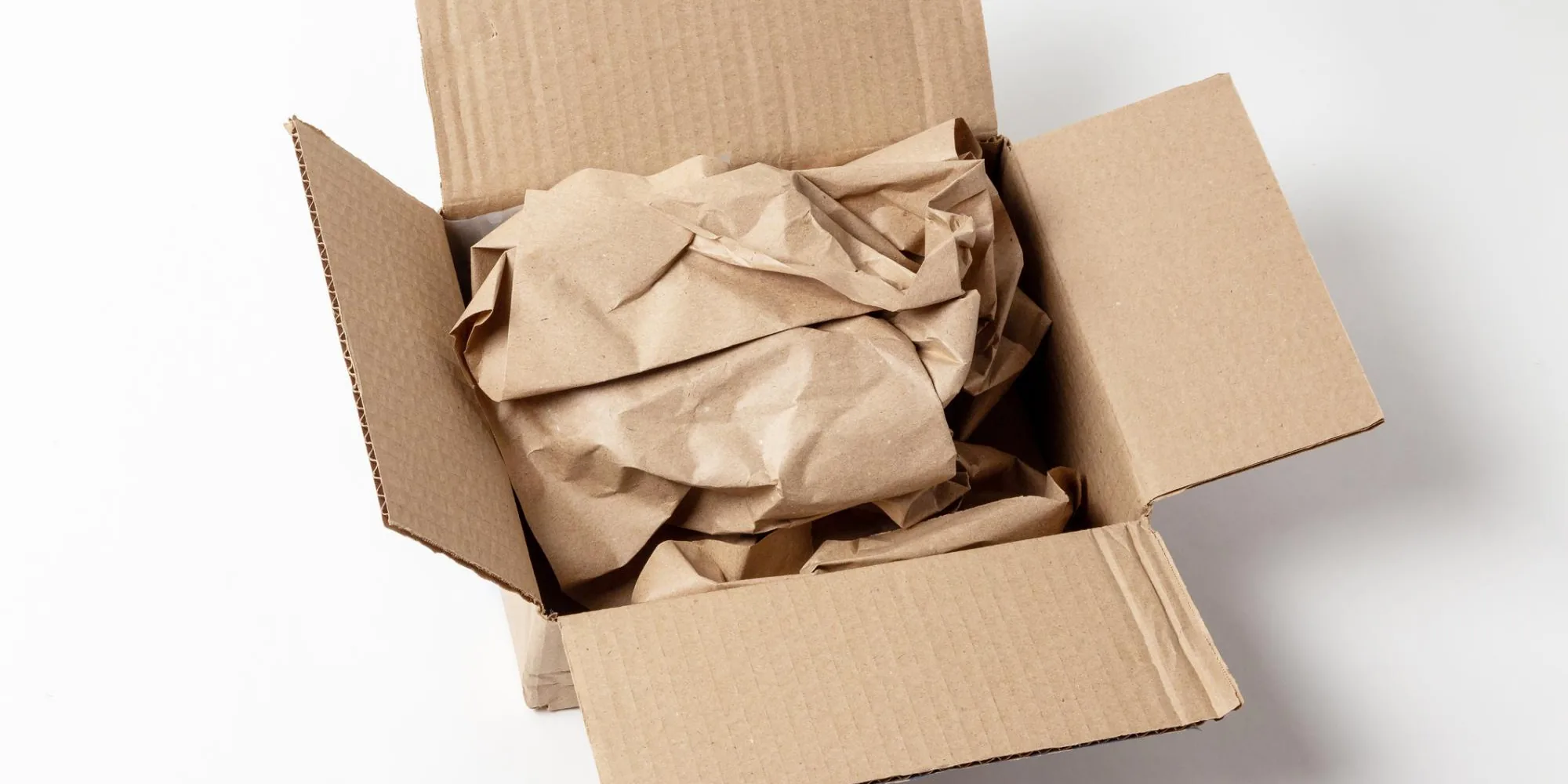
What works: Kraft paper is the easy pick. Loosely crumpled kraft paper or shredded paper will fill the gaps around the item. If the product has delicate print or a soft finish, go for tissue paper, which is gentler on it. And if you’ve got a lightweight product in a box with a big gap, small air pillows do the job.
Where this can go wrong: Don’t overdo it. A light item does not need packing that fights the flaps closed. Also, pick the box size first. A product that is the right size for its box needs very little filler. Our range of shipping cardboard boxes comes in sizes that suit small products, so you are not filling a large box with paper.
Void Fill for Products from 500g to 2kg
This band covers candles, bottles, mugs, books, and many boxed kitchen products. The product has enough weight now to push against the filler. It will crush loose paper and dent air pillows if it gets thrown about.
What works: With glass, ceramic or anything polished, wrap the product before anything else. Bubble wrap looks after the surface and gives a bit of cushioning. After wrapping, pack paper around the product to fill what’s left. On paper vs. bubble wrap, paper fills space while bubble wrap protects surfaces. That’s why many packers use both.
Some packers combine two fillers. The paper holds the product in place, and the air pillows take care of the space that’s left. It costs less, and the product still can’t move.
When one box holds several items, bottles for example, corrugated dividers are a good idea. Each item gets its own space and can’t knock against its neighbour.
Where this can go wrong: Air pillows alone aren’t up to the job. Sure, they fill big spaces, but a heavy or fragile product gets hardly any cushioning from them. Loose packing peanuts have their own problem. During transit, they can sink down, and that leaves a gap at the top of the box. The product then moves.
Void Fill for Products from 2kg to 10kg
At this weight, the job changes. You are no longer filling space. You are bracing a product that wants to move.
Why loose fill struggles: A heavy product leans hard on whatever is packed around it. Crumpled paper and packing peanuts can’t take that load, so they flatten, and the product starts to move somewhere along the way. Inflated air pillows hold up better, although they can burst.
What works: Fitted corrugated inserts hold the product in place. In packing terms, this is called blocking and bracing. They’re cut or folded to the product’s shape, so it can’t slide. Foam does the same job if the product’s surface is delicate. Paper or air pillows can then deal with any small gaps still left. For a heavier product, we check its weight against the insert’s contact area before the cut pattern is set. That way, no single point carries the load.
The box has to carry the weight as well. A thicker board or a double-wall box may be needed. Our post on how much weight a cardboard box can hold explains how board strength is rated and how to read the box maker’s stamp -our shipping box strength guide covers board grade in more depth if you want to check a specific spec.
Void Fill for Products Over 10kg
Loose void fill is not enough at this weight. Heavy products need a fitted solution.
Use fitted supports: To keep the product in the middle and away from the walls, use corrugated bases, side supports and spacers. Put it on a firm base pad too. That way the weight spreads over the bottom of the box and doesn’t sit on one small spot. Dense foam blocks do the same for products that need a softer touch.
Check the box first: A heavy product in a weak box will split the walls, whatever filler is inside. The box needs the right board grade and the right internal size. We size a base pad to the product’s footprint and check it against the board grade before production starts. That spreads the weight over the whole bottom of the box. For products like these, a box made to fit the item is often the best answer. It takes away most of the gap, so you need very little filler.
Void Fill for Fragile and Sturdy Products
Weight is only half the picture. How delicate the surface is, and how sturdy the structure is, matter too. A 1kg glass bottle and a 1kg folded jumper need packing that’s nothing alike.
Fragile items: When it comes to void fill for fragile items, the first thing touching the product should be soft. Glass, ceramics, electronics and polished finishes all fall into this group. Wrap the item in foam or bubble wrap first. After that, fill whatever space remains with paper or another filler. The wrap looks after the surface. The filler stops the wrapped product from moving.
Sturdy products: Things like linens, clothing, boxed tools and cleaning supplies cope with rough handling much better. Kraft paper or air pillows are usually enough. These products mainly need to stay put, and a light filler does that at low cost.
Void Fill for Mixed and Multi-Item Orders
Packing several products in one box adds a new risk. The items can hit each other. Put a heavy item on top of a light one, and it may crush it.
Start with the heaviest items at the bottom and work up, so the lightest ends up on top. Give each product its own wrapping, or put paper or a corrugated divider between them. Don’t forget the gaps between items, not only the ones around the edges. After that, shake test it once more. With mixed items, a box can feel firm on one side and loose on the other.
Protective Packaging Fillers UK: How the Main Options Compare
Each filler here is judged on three checks: how well it holds the product, what it adds to parcel weight and what the customer can do with it afterwards. The table below sets out the main options. Read the weak points column before you buy. Every council has its own rules on what it collects, so look up your local guidance before telling customers how to get rid of the packaging.
| Filler | Best for | Weak point | UK recycling |
| Kraft paper | Light and medium products, odd-shaped gaps | Flattens if packed loosely, and it adds weight | Usually kerbside, as long as it’s uncoated |
| Air pillows | Large gaps around products that aren’t fragile | Can burst, and give heavy items very little cushioning | Soft plastic. Not taken at kerbside, but many supermarkets accept it |
| Bubble wrap | Wrapping fragile or polished products | Takes up a lot of storage space | Soft plastic. Not taken at kerbside, but many supermarkets accept it |
| Packing peanuts | Irregular shapes, tight gaps | Compress under stacking, settle in transit | Varies by type, check locally |
| Corrugated inserts | Heavy items, bottles, bracing | Must be cut or folded to fit | Usually with cardboard if no plastic coating |
| Foam | Delicate surfaces, fitted cavities | Harder to recycle | Check locally |
Paper is the easiest recyclable void fill to dispose of. Household recycling bins in the UK don’t usually take plastic film like bubble wrap and air pillows. Many supermarkets take it at their plastic film collection points instead.
How Packing Speed and Storage Change the Choice
The best filler on paper may not suit your packing bench. Three practical points are worth checking.
Order volume. For small volumes of mixed products, kraft paper and bubble wrap are flexible. They work in any box size without special equipment. At higher volumes, air pillows or pre-cut paper are faster, though air pillows usually need an inflation machine.
Storage space. Rolls of bubble wrap eat up shelf space before they’re used. You can keep air pillows flat until it’s time to inflate them. Paper is simple, as it comes in rolls or packs.
Packing time. Peanuts and other loose fill take more time per box than paper or air pillows do. Pack plenty of boxes in a day and those extra seconds start to count.
Common Void Fill Mistakes
Most packing problems come from the same few habits.
- Not doing the shake test. A box can look full and still let the product move.
- Going by the outside measurements. The walls eat into the space, so the inside is smaller, and the actual gap isn’t what you worked out.
- Using loose paper for a heavy product. It compresses, and before long the product is moving about.
- Overfilling. Packing so full that the flaps bulge puts the box under pressure and could split the seams.
- Using only air pillows for something fragile. They fill space but cushion very little.
- Using a big box for a small product. You end up spending time and weight on extra filler.
Sometimes a Better-Fitting Box Beats More Filler
Want less void fill? Get the box size right for the product before anything else. With a snugger box, you use less filler, pack faster and send a lighter parcel. Paper isn’t weightless either, and if you’re charged by weight it can push your costs up.
Here’s how we size a corrugated box. We take the product’s measured length, width and height, then allow for the filler. So the gap is sorted from the very first box, and you aren’t adjusting it afterwards. If your quote request includes the product’s weight and photos, we choose the board grade and insert type together. The filler plan is then part of the box spec from the start.
Do you ship the same product again and again? A made-to-measure box is usually worth considering. You can see what is available in our corrugated packaging range.
If part of your range is sold in shops as well as shipped, the fitting and bracing principles here carry over directly -see our guide to corrugated display boxes UK for how the same “hold it still” logic applies to products sitting in a shelf-ready tray.
Conclusion
The right void fill for cardboard boxes depends on the product’s weight and surface. Light items need gentle paper or small air pillows. For 500g to 2kg, wrap the product and brace it with paper. Anything heavier needs fitted corrugated inserts or foam, and past 10kg it’s best to have a fit made specially.
Some simple habits protect most parcels. Always measure the inside of the box and not the outside. Wrap fragile surfaces before you fill around them. Run the shake test every time, and again after the box has been pressed for a while. If the product still moves, use more filler or a firmer one. If the flaps bulge, take some out.
Best of all is to need less filler to begin with. When the box fits the product, there’s hardly any gap left to fill. You save packing time, keep parcel weight down and cut the risk of damage.
At Hale Path Packaging, we make shipping cardboard boxes and custom corrugated boxes. Our orders start at 100 units, with production taking 7 to 14 working days. Tell us your product’s size and weight, and we’ll size the box so there’s far less void fill to deal with.
Written by the Hale Path Packaging team, packaging specialists with 10 years of experience supplying corrugated, rigid and custom packaging to start-ups and established brands across the UK.

Harry Taylor
Packaging expert at Hale Path Packaging, sharing insights on custom packaging solutions, sustainable materials, and industry trends.