

UK Plastic Packaging Tax vs EPR: What’s the Actual Difference (and Do You Owe Both)?
Plastic Packaging Tax (PPT) and Extended Producer Responsibility (EPR) are two separate UK charges, not one. PPT is a per-tonne tax on plastic packaging with less than 30% recycled content (£228.82/tonne from April 2026), collected by HMRC. pEPR is a disposal-cost fee on all packaging materials, collected by the Environment Agency or a compliance scheme. Paying one never exempts you from the other, and most businesses that clear one threshold clear both.
Ask most UK packaging businesses which green charge they’re dealing with, and they’ll usually name one. In practice, there are two, and if your business is caught between them, you’re almost certainly paying both. This piece breaks down what PPT and EPR actually charge for, whether you owe one, both, or neither, a worked cost example, and where the two schemes can actually be reduced together instead of tackled one at a time.
Businesses budget for one packaging charge and get billed for two – not because they missed something, but because PPT and EPR were never designed to overlap cleanly.
Start with the core distinction, since that’s where most of the confusion begins. Plastic Packaging Tax is a per-tonne tax on plastic packaging containing less than 30% recycled content, currently £228.82 per tonne from April 2026. EPR works differently – it’s a disposal-cost fee covering all packaging materials, not just plastic, calculated on weight, material type, and how easy that packaging is to recycle. Different formulas, different bodies collecting them, and paying one never exempts you from the other, which is exactly why a business that clears both thresholds ends up with two separate bills, for two separate reasons.
Most businesses obligated under one scheme are obligated under the other too. The thresholds overlap closely enough that “I already deal with PPT” is not a safe reason to assume pEPR doesn’t apply, or the other way round.
What Is the UK Plastic Packaging Tax vs EPR?
PPT was introduced in April 2022 as a straightforward incentive: use recycled plastic or pay a premium for using virgin material. The mechanics haven’t changed much since launch, though the rate rises each year in line with inflation.
The current rate is £228.82 per tonne, up from £223.69 the previous year. It applies to any plastic packaging manufactured in the UK or imported into the UK that contains less than 30% recycled plastic by weight. Hit that 30% threshold and the packaging is exempt from tax, though you may still be required to report it.
Who Has to Register for PPT
Registration kicks in once a business manufactures or imports 10 tonnes or more of finished plastic packaging within a rolling 12-month period. This is worth repeating because it catches people out: you must register even if none of your packaging is actually taxable. If you’re above the 10-tonne threshold but everything you produce already contains 30%+ recycled content, you still register – you just won’t owe any money.
Registration and liability are two different questions. Crossing the 10-tonne threshold means you must register with HMRC, full stop, whether or not any tax is actually owed once your recycled-content figures are in.
The obligation applies at the level of individual components, not finished products. A plastic-lidded jar with a paperboard sleeve, for example, requires the lid to be assessed separately from the sleeve. Where a packaging item combines multiple materials, whichever material makes up the largest share by weight determines how it is classified for tax purposes.
What happens if I don’t register for PPT once I’m above the threshold? HMRC can charge penalties for late registration and inaccurate returns, calculated separately from any tax owed – so a business that assumes it’s exempt and skips registration altogether is exposed even if it would have owed nothing once its recycled-content figures were filed.
How the Rate Is Calculated
The calculation itself is simple multiplication: total tonnage of taxable plastic packaging multiplied by £228.82. There’s no sliding scale or banding – a business importing 15 tonnes of taxable plastic pays the same £228.82-per-tonne rate as one importing 1,500 tonnes.
Recycled content evidence matters more than most businesses expect. Under proposed changes due from April 2027, post-consumer recyclate will count toward the 30% threshold; pre-consumer factory offcuts, which many businesses currently rely on to hit the exemption, will no longer qualify. A parallel consultation is also looking at tightening evidence requirements for recycled content claims, particularly on imported packaging where verification is harder.
Does PPT apply to packaging I export from the UK? No. PPT applies to plastic packaging manufactured in or imported into the UK for the domestic market. Packaging exported before being filled or used to export goods falls outside its scope.
What Is Extended Producer Responsibility for Packaging?
EPR works on a completely different principle. Instead of taxing the composition of your packaging, it charges you for the cost of disposing of it once it becomes household waste. The revised UK scheme, generally referred to as pEPR, replaced the older Packaging Recovery Note (PRN) system in April 2025 – a system where producers historically covered only a small fraction of actual disposal costs, with local councils and taxpayers absorbing the rest.
Under pEPR, producers now pay the full cost of collecting, sorting, and recycling the household packaging they place on the market. This applies across all packaging materials – plastic, glass, paper and card, aluminium, steel, and wood – not just plastic.
Who’s Obligated Under pEPR
Two thresholds determine whether you’re in scope at all: annual turnover of £1 million or more, and responsibility for more than 25 tonnes of packaging in a calendar year. Fall below either threshold, and you’re non-obligated – no data reporting, no fees.
Above those thresholds, you’re split into two tiers:
- Small producers – turnover between £1 million and £2 million with 25+ tonnes of packaging, or turnover above £2 million with 25–50 tonnes. Must report packaging data but, as things currently stand, aren’t required to pay the disposal (waste management) fee.
- Large producers – turnover above £2 million and more than 50 tonnes of packaging. Pay the full disposal fee on top of reporting obligations, and must also purchase evidence of recycling through Packaging Waste Recovery Notes (PRNs) or Packaging Export Recovery Notes (PERNs).
Will small producers have to pay EPR fees eventually? As things stand, small producers are exempt from the disposal fee itself, but they still carry full reporting obligations, and government guidance has signalled this is likely to be reviewed as the scheme matures – worth treating the current exemption as a current-year position rather than a permanent one.
How pEPR Fees Are Calculated
In the scheme’s first year (2025–26), fees were charged as flat base rates per tonne, regardless of how recyclable the packaging actually was. Plastic was set at £423 per tonne and glass at £192 per tonne, both considerably higher than the PPT rate, and calculated on total packaging tonnage rather than just the non-recycled-content portion.
From the second year (2026–27) onward, fees shift to a modulated, recyclability-based model using PackUK’s Recyclability Assessment Methodology (RAM) and a red-amber-green (RAG) rating system. PackUK’s own indicative figures for 2026–27 put plastic rising to around £455/tonne and glass to around £205/tonne on the base rate before modulation, with green-rated packaging attracting a lower fee and red-rated packaging – hard to sort, hard to recycle, or contaminating other recyclable material – attracting a materially higher one. This is the mechanism designed to reward better packaging design over time, rather than simply taxing weight.
PPT vs EPR at a Glance
| Plastic Packaging Tax (PPT) | Extended Producer Responsibility (EPR) | |
| What it taxes | Plastic packaging under 30% recycled content | All packaging materials, based on disposal cost |
| Materials covered | Plastic only | Plastic, glass, paper/card, aluminium, steel, wood |
| Current rate | £228.82/tonne (from April 2026) | £423/tonne plastic, £192/tonne glass (2025–26); modulated by recyclability from 2026–27 |
| Who’s in scope | 10+ tonnes of plastic packaging manufactured/imported per year | Turnover £1m+ and 25+ tonnes of packaging per year |
| Registration body | HMRC | Environment Agency (or devolved equivalent) / compliance scheme |
| What triggers exemption | 30%+ recycled plastic content | Falling below both the turnover and tonnage thresholds |
| Reporting frequency | Quarterly returns | Twice yearly (Jan–Jun and Jul–Dec data periods) |
| Still report if exempt? | Yes, if above the 10-tonne threshold | Yes – small producers still report even without paying fees |
Do You Owe Both PPT and EPR?
This is the question most businesses actually want answered, and the honest response is: it depends on your volumes, but there’s real overlap in the businesses that qualify for each.
Since PPT registration starts at just 10 tonnes of plastic packaging, and pEPR obligation starts at 25 tonnes of all packaging combined, a mid-sized business shipping plastic-heavy products can easily clear both thresholds at the same time. There’s no offset between the two. Paying PPT doesn’t reduce your pEPR fee, and having pEPR-compliant, high-recyclability packaging doesn’t exempt you from PPT if that same packaging happens to sit under the 30% recycled-content line.
There is no offset between PPT and pEPR. Paying one does not decrease, excuse, or count toward the other – they’re evaluated completely independently, even when both are triggered by the same batch of packaging.
A useful way to think about it: PPT asks what your packaging is made of. PEPR asks what happens to it after the customer throws it away. A plastic pouch could be liable for both – taxed under PPT because it uses less than 30% recycled content, and charged a higher EPR fee because flexible plastic film is harder for councils to sort and reclaim than rigid plastic or card. A mono-material kraft pouch avoids exactly this trap, since a single-material structure is both easier to hit the recycled-content threshold with and easier to rate Green under pEPR.
Businesses Likely to Owe Both
- Mid-sized e-commerce or DTC brands shipping products in plastic mailers, pouches, or shrink-wrapped multipacks at meaningful volume
- Food and beverage producers using plastic trays, film lidding, or flexible pouches without recycled content
- Any business above £1 million turnover that imports finished, packaged goods rather than manufacturing packaging domestically – the import counts toward both thresholds
Can I be liable for pEPR but not PPT, or the other way round? Yes, easily. A business shipping mostly glass or card with only a small amount of plastic could clear the EPR tonnage threshold on total packaging weight while staying under PPT’s 10-tonne plastic-specific threshold. The reverse is true for a plastics-only business that’s too small or low-turnover to trip pEPR’s £1 million/25-tonne combined test.
Common misconception worth flagging directly: registering for one scheme does not automatically register you for the other. PPT is administered by HMRC; pEPR sits with the Environment Agency or your chosen compliance scheme. They don’t share a single registration, and missing one because you assumed the other “covered it” is a compliance gap regulators are actively checking for.
Worked Example: A Mid-Sized Business Paying Both
Consider a hypothetical business with £3 million annual turnover, importing 40 tonnes of plastic packaging a year, all of it under the 30% recycled-content threshold.
| Scheme | Calculation | Annual cost |
| PPT | 40 tonnes × £228.82 | £9,152.80 |
| pEPR (plastic portion, 2025–26 flat rate) | 40 tonnes × £423 | £16,920.00 |
| Combined exposure to plastic packaging alone | £26,072.80 |
This business also crosses both the £2 million turnover and 50-tonne packaging points if its total packaging (including other materials) exceeds 50 tonnes, so its full pEPR bill depends on what else it ships in glass, card, or other materials – and that £16,920 plastic-only figure doesn’t yet include the recyclability-based modulation due from year two onward.
A single 40-tonne plastic packaging line can generate over £26,000 a year in combined PPT and EPR exposure – before accounting for any other materials in the mix, or the fee increases due from 2026–27. This is why treating PPT and EPR as basically the same green tax is a costly assumption; a business budgeting for one of these figures will get caught short by the other.
How to Reduce Exposure to Both
The overlap between the two schemes means the most effective packaging changes tend to support both bills at once, though not always in equal proportion.
Increasing recycled content past 30% removes the PPT liability entirely on that component. It also – though not automatically – improves your pEPR recyclability rating, since higher-PCR plastic is more likely to be accepted through standard recycling streams.
Switching to mono-material construction, where a laminated or multi-material pouch is replaced with a single-polymer equivalent, tends to move packaging toward a greener pEPR rating, since mixed-material laminates are one of the harder categories for councils to sort and process. It doesn’t affect PPT directly unless it also changes the recycled-content percentage.
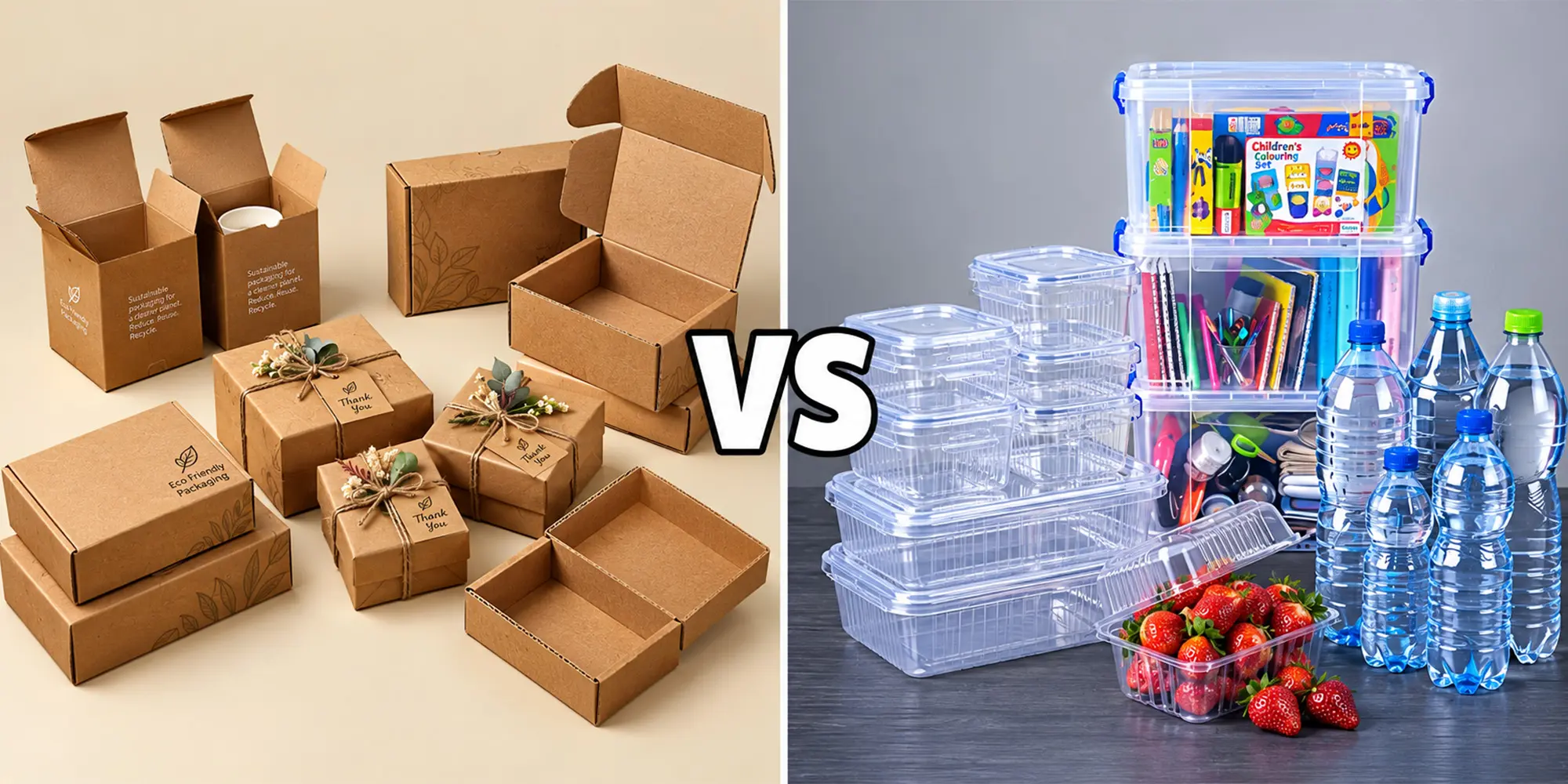
Moving weight out of plastic and into paper-based formats where the product allows it takes that component out of PPT scope altogether, since PPT only applies to plastic. Our corrugated boxes range is a common substitution point for exactly this reason. It also generally reduces pEPR fees, since paper and card carry a lower base rate than plastic or glass under the current fee structure.
Testing packaging changes against both thresholds before committing to a redesign avoids the trap of solving for one scheme while accidentally increasing exposure to the other. A heavier board-based alternative might clear PPT scope entirely while adding enough material weight to tip total packaging tonnage into pEPR’s large-producer bracket – the same trade-off we work through with brands specifying our rigid boxes range against a lighter format.
Conclusion
PPT and EPR are frequently talked about as though they’re variations on the same idea, but they’re built on different logic, run by different regulators, and calculated on entirely different figures. A business can be liable for one, both, or neither, and the only way to know which applies is to run the actual tonnage and turnover numbers against each scheme’s separate thresholds, rather than assuming compliance with one covers the other.
For packaging specification questions that sit alongside these calculations – recycled content percentages, mono-material construction, or material substitution to reduce combined exposure – Hale Path Packaging works through these trade-offs directly with brands at the design stage, before a packaging spec is locked in, rather than after a fee notice arrives.
This article is intended as general information on UK packaging regulation and isn’t a substitute for professional tax or compliance advice. Businesses should confirm their specific obligations with HMRC (for PPT) and the Environment Agency or their chosen compliance scheme (for pEPR), or consult a qualified adviser.

Harry Taylor
Packaging expert at Hale Path Packaging, sharing insights on custom packaging solutions, sustainable materials, and industry trends.