
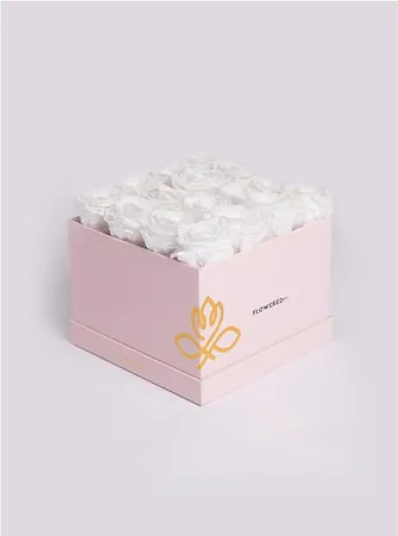

White rigid gift boxes UK buyers order are really two decisions: the greyboard or chipboard core underneath (typically 800gsm to 2000gsm) and the lamination grade protecting the white surface on top. Get those right, and white becomes the most versatile finish for a Christmas gift range – one box shape, foil or spot UV branding carrying the seasonal look. Get them wrong, and a thinner core shows through as scuffing that gets blamed on “white just marks more,” when it’s actually an under-specified box.
Ask five UK suppliers what makes a“premium” white rigid box, and you’ll get five identical answers: strong material, elegant look, low MOQ. None of them will tell you what’s under the coating, why the last batch came back scuffed, or why the same-looking box from two different suppliers can cost 30% apart. That’s usually down to one thing: the greyboard or chipboard core underneath the white surface, typically 800gsm to 2000gsm, and the lamination grade protecting it. Get those two right, and white becomes the most versatile finish in a Christmas gift packaging UK range. Get them wrong, and “white shows more, that’s normal” becomes the excuse for a spec that was never right to begin with.
This guide covers what’s actually inside a white rigid box, why it marks more easily than other finishes, how to size and close it correctly, and what to check before locking in a Christmas print run.
In this blog:
- What’s inside the box, and why does core thickness change the price more than the finish does
- Why white shows scuffing and marks that other colourways hide, and how to prevent it
- How to get sizing, closure, and lead time right before a Christmas run
Why White Rigid Gift Boxes UK Have Become the Default for Christmas Gifting
A neutral base for a whole seasonal range. Rigid gift boxes in white work for Christmas because they’re a neutral base. A retailer selling hampers, candle gift sets, jewellery, luxury chocolate, festive cakes, or cosmetic gift box sets can use the same box shape across a whole seasonal range and let the ribbon, sleeve, or foil print carry the festive branding, rather than committing to a Christmas-specific colourway that’s dead stock in January. Our own rigid gift boxes UK range is built around exactly this idea – one box shape carrying a whole seasonal collection.
Why do brands choose white rigid boxes for Christmas gifting? White works as a neutral base that carries branding through ribbon, sleeve, or foil print rather than the box colour itself, which means the same box shape can be reused across a whole seasonal range instead of becoming dead stock once Christmas ends. White also shows foil stamping, spot UV, and metallic inks more clearly than kraft or coloured board, which matters for gifts that are likely to be unwrapped or photographed on camera.
Why do foil and spot UV read cleaner on white? There’s also a practical unboxing reason. White reflects light in a way that makes foil stamping, spot UV, and metallic inks more visible against the surface than they are on kraft or coloured board. For a gift that’s likely to be photographed or unwrapped on camera, that contrast counts more than people expect.
Where white loses to kraft or colour. White isn’t always the right call. A rustic or eco-positioned brand often gets more from a kraft or recycled-fibre finish, since white board leans formal and retail-polished rather than natural – closer to what you’d see across our retail packaging boxes UK range than a hamper or gift set. It’s worth deciding on the brand positioning first and the colourway second, not the other way round.
What’s Honestly Inside the Box?
Greyboard and chipboard: the structural core. The white surface you see is a layer, not the structural material. A greyboard or chipboard core, typically 800gsm to 2000gsm, does the actual work of holding the box’s shape. It’s wrapped in a clay-coated white paper, usually 300gsm to 450gsm, which is where the smooth, printable finish comes from.
What determines the price difference between two similar-looking white rigid boxes? Core thickness, not the visible finish. A supplier quoting a noticeably lower price on a “standard” white rigid box is very often quoting a thinner greyboard or chipboard core, not a genuine discount on the same spec. Two boxes that look identical in a product photo can carry very different board weights – ask for the core spec in gsm or mm directly, not just the word “rigid” or “premium,” since that’s exactly where a cheaper quote usually comes from.
| Core thickness | Best suited to | Typical closure |
| 1.2mm to 1.5mm | Cosmetics, jewellery, small accessory sets | Two-piece lid and tray |
| 1.8mm to 2.0mm | Standard lidded gift boxes, most Christmas retail ranges | Telescopic lid |
| 2.2mm and above | Magnetic closures, heavier or fragile contents | Magnetic closure |
Does White Show Marks More Than Other Finishes?
Does a white rigid box scratch or scuff more easily than other colours? Yes – and this is the part most competitor pages skip entirely. A white-coated surface reveals corner rubs, fingerprints, and transport scuffing more visibly than kraft, black, or a printed pattern would on the same box construction. It’s not a flaw in the material; white simply has nothing to hide behind, so any surface disturbance shows up more clearly than it would on a darker or patterned finish.
The fix isn’t a thicker board on its own. It’s a combination of a proper matte or soft-touch lamination over the coated paper, corner protection in the outer carton during shipping, and, where the budget allows, an anti-scuff film on high-contact panels like the lid edges. Flagging this early with clients ordering white for the first time matters because it’s the single most common reason a first batch comes back with a complaint that has nothing to do with the box’s actual strength.
Matte vs. soft-touch vs. gloss. A matte lamination hides light surface marks best and is the most standard selection for retail ranges. Soft-touch adds a velvety feel that reads as more elegant but marks slightly more easily under heavy handling. Gloss looks striking in photography but shows fingerprints fastest of the three, so it works best for boxes handled once, at unboxing, rather than constantly on a shop stand.
What we’d actually ask before quoting a Christmas run:
- How is it travelling to the end customer? A box shipped directly to a consumer needs more corner protection than one going into a retail display where it’s handled once.
- What’s going inside it, and how heavy is it? A 2.2mm core for a lightweight scarf is money spent on strength you don’t need. The same core under a boxed candle set is the right call.
- Is this a one-off seasonal run or a shape you’ll reuse? If you’ll reuse the box outside Christmas, it changes whether a Christmas-specific print run or a neutral white base with a removable sleeve makes more sense.
Sizing It Correctly for What’s Inside
Standard size bands. Most UK suppliers work to a handful of standard size bands instead of building every box from scratch: small jewellery, accessories, medium cosmetics, single gift items, large clothing, gift sets, extra-large hampers, and corporate gifting. Starting from the closest standard band and adjusting to the product is cheaper than a bespoke size from scratch, since it avoids new tooling.
Fit tolerance and why it matters. A box that’s too loose lets the product shift and scuff both the item and the box interior during transit. A box that’s too tight makes the lid hard to seat properly and stresses the corners over time. As a general rule, 2 to 3mm of clearance around the product or its insert gives a snug fit without forcing the lid. For flat or oddly-shaped items, our custom die-cut boxes UK page covers non-standard shapes that a standard-size band won’t fit well.
Getting the size right the first time avoids paying for a second dieline because the original was guessed rather than measured.
Getting the Closure Right for a Gift, Not Just a Box
Closure style changes both the cost and the unboxing feel more than most first-time buyers expect.
What’s the difference between a telescopic lid, a two-piece lid, and a magnetic closure box? A telescopic lid runs the full depth of the base, giving the strongest structure and the cleanest-looking seam – the closure most commonly used across UK Christmas gift box ranges. A two-piece lid and tray, where the base stays partly visible, opens more easily by hand and suits gift sets a customer is likely to open more than once, similar to our box with a separate lid UK range for repeat-use gifting. A magnetic closure adds a premium, book-like feel and works well for higher-value items, but needs a slightly thicker core to hold the magnet properly, generally from around 2.2mm upward – our guide to magnetic gift boxes UK pricing breaks down when that extra cost is worth it. None of these is automatically “the premium option” – the right one depends on what’s going inside and how the recipient is meant to experience opening it.
A Pattern Worth Recognising
This is a common failure pattern in the category, not one specific client’s story: a brand’s boxes arrive with visible corner wear on around one in ten units, and a previous supplier simply says, “white shows more; that’s normal.” That’s partly true, but the real cause is usually a thin-coated wrap over a core that’s slightly undersized for the product weight, combined with no corner protection in the outer shipping carton. Moving to a heavier core and adding a matte lamination plus scuff-resistant corner packs typically bring the damage rate down without changing the visual design at all.
Printing and Branding Without Losing the Clean Look
Foil stamping and spot UV. White is forgiving for print but unforgiving for mistakes, because there’s no background pattern to soften an off-register foil stamp or an irregular varnish coat. Foil stamping and spot UV both read cleanly against a plain white surface, which is why they’re the two most standard finishing selections for Christmas ranges.
Digital printing and proofing. Full-colour digital printing works too, but it’s worth asking your supplier for a physical proof rather than a digital mockup, since white surfaces can shift the perceived colour of a print more than a coloured or kraft base would. A lighter coating can let ink feather slightly on very fine detail – something that rarely shows up on a screen proof, which is why fine linework and small text are worth checking against the coating grade before a job goes to print.
Inserts and Interior Presentation
The inside of the box is part of the unboxing moment too. A card or foam insert, a tissue liner, or a printed interior panel all add cost but also add the sense that the box was designed for the product rather than borrowed from a generic size run. For smaller gifts where a full rigid structure isn’t needed, our pillow boxes UK range is worth a look as a lighter alternative. For higher-value gifts, insert spend is often where the money has more visible impact than an extra finish on the exterior.
Is It Recyclable in the UK?
Are white rigid gift boxes recyclable through standard UK kerbside collection? Not automatically. The greyboard core itself is reclaimable, but a laminated finish – gloss film or foil detailing – can mean the box isn’t accepted in standard kerbside collection without checking with the local council first. This is a detail almost no competitor page mentions, and it matters to buyers whose own customers ask about it before they order.
If recyclability is part of the brand story, ask specifically for water-based or aqueous layers instead of laminate film, and for certified board where the supplier can confirm chain of custody. These selections cost slightly more, but the box ends up being reclaimable in practice, not just reusable in name.
Timing It for Christmas
Production lead times. Rigid box production isn’t a quick turn. Between dieline approval, proof sign-off, and the physical build – score, wrap, assemble – most UK suppliers need somewhere in the region of three to five weeks for a first Christmas order, longer if foil stamping or a magnetic closure is involved. Reorders on an approved spec move faster, since the dieline and proof stage are already done.
Locking in the spec early. If a white rigid gift box is part of this year’s Christmas range, the safest window to lock the spec in is now, before courier peak-season surcharges and supplier capacity both tighten nearer to November.
The Bottom Line
White rigid gift boxes UK brands rely on earn their place as the country’s go-to Christmas presentation packaging because it’s a neutral, reusable shape that lets foil stamping and spot UV do the branding work, not the box colour itself. But the spec is what decides whether a box photographs beautifully or comes back scratched: the right core thickness for the product weight, a proper matte or soft-touch lamination to handle white’s visibility to marks, an accurate fit tolerance around the product, the correct closure style for how the gift will actually be opened, honest recyclability instead of laminate dressed up as sustainable, and a lead time locked in before Christmas capacity tightens.
Get those right, and the box does its job without drawing attention to itself. Get them wrong, and “white shows more, that’s normal” becomes a reason for a spec that was never right in the first place.
Questions worth asking your supplier:
- What core thickness – gsm or mm – is honestly quoted, not just “rigid” or “premium”?
- Is the white layer laminated matte, soft-touch, or gloss, and how does that affect scuff resistance?
- What corner or edge protection is included for transport, if any?
- Is the closure style – telescopic, two-piece, magnetic – matched to what’s going inside, or just the cheapest default?
- Is the finish kerbside-recyclable, or does the lamination need checking with the local council first?
- What’s the realistic lead time for this spec specifically, including any foil or magnetic add-ons?
Hale Path Packaging runs the white rigid box range with a 100-unit minimum order and a typical turnaround of 7 to 14 working days once a spec is approved.
Get a quote for your white rigid gift boxes, or browse our wider retail packaging range – we’re happy to talk through core thickness, closure style, or lamination before you commit to a print run.

Harry Taylor
Packaging expert at Hale Path Packaging, sharing insights on custom packaging solutions, sustainable materials, and industry trends.