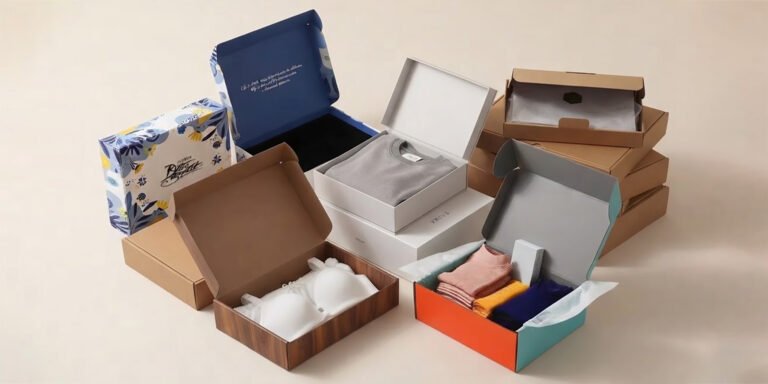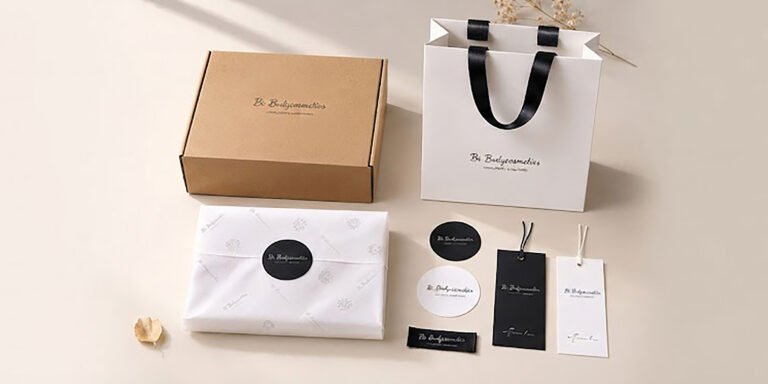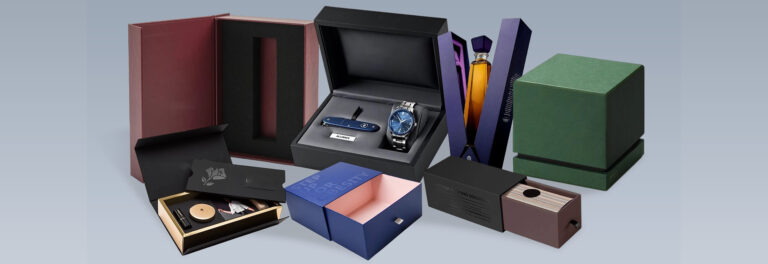

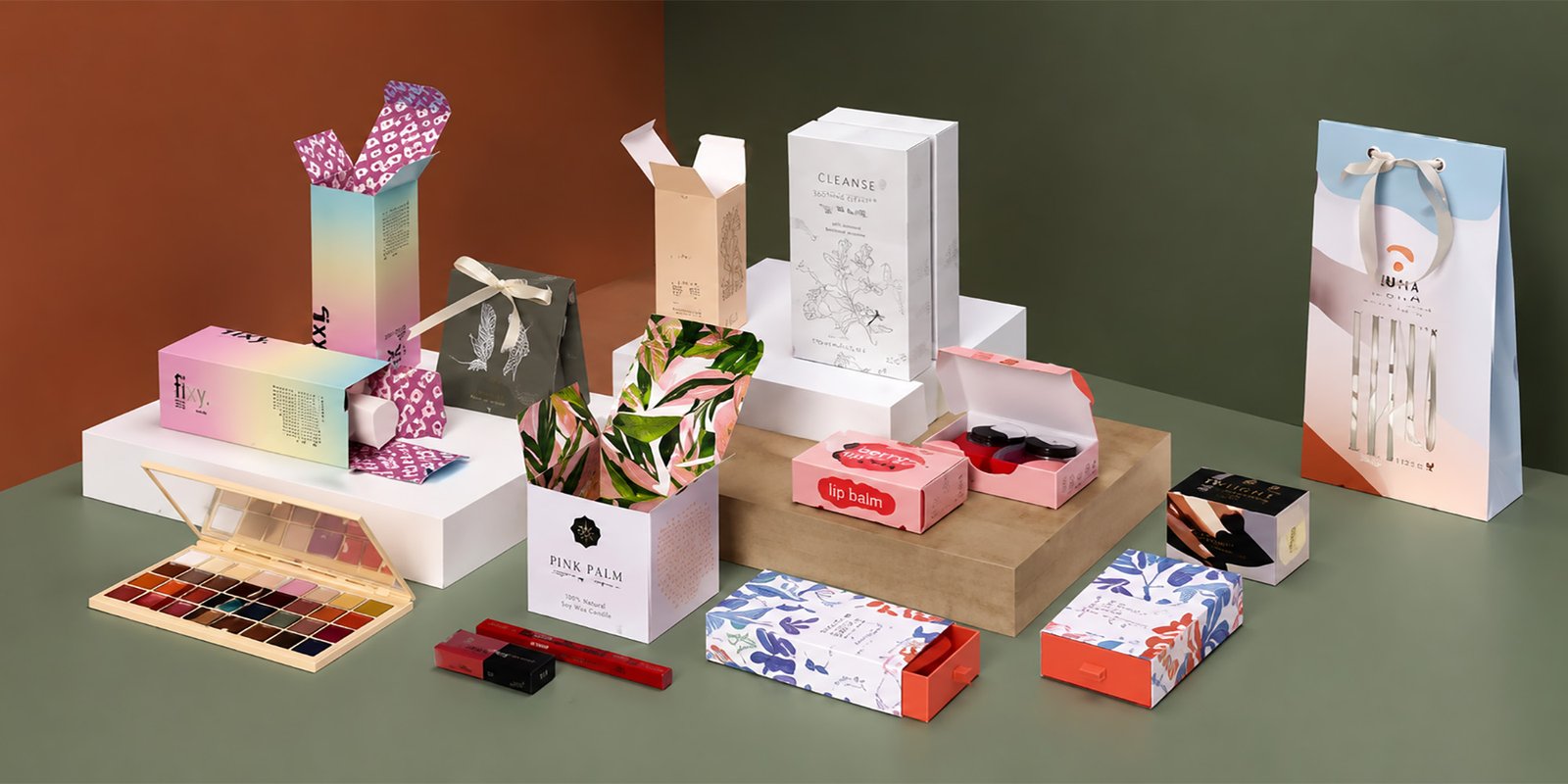
Custom cosmetic packaging cost UK runs from roughly £0.45 to £4.80 per unit depending on format, board grade, finish and order volume – a plain folding carton at 5,000 units sits at the low end, a soft-touch rigid box with foiling and a magnetic closure at 250 units sits at the high end. Two costs sit on top of that unit price and rarely appear on a supplier’s quote: Plastic Packaging Tax (£228.82 per tonne from April 2026, on any plastic component under 30% recycled content) and EPR disposal fees (from £192 to £545 per tonne depending on material and recyclability rating). Once both are factored in, format choice becomes a total-landed-cost decision, not just a print quote comparison – which is what this guide actually breaks down.
No single number defines cosmetic packaging cost in the UK – it’s built from several moving parts stacked on top of each other. Material sets the baseline, print and finish decide how far above it you go, and volume determines how much of the fixed cost each unit actually carries. Most pricing guides stop there. Two more costs now sit on top for UK brands – Plastic Packaging Tax and EPR fees – and both changed rates in 2026. This guide covers all of it, with real price bands, not vague ranges.
What Actually Drives Custom Cosmetic Packaging Cost UK
What determines the cost of custom cosmetic packaging? Four factors stack together: board or material grade sets the baseline cost, print method and finish add on top of it, order volume determines how much of the fixed setup cost each unit carries, and – specifically for 2026 – Plastic Packaging Tax and EPR disposal fees add a regulatory layer most quotes don’t itemise separately.
Material and board grade. Board weight is the first number that moves the price on a folding carton. A carton produced on 300gsm folding boxboard (FBB) costs noticeably less than the same box on 400gsm – and the difference is felt at the point of sale, since heavier stock feels more substantial in hand, which matters for cosmetics more than almost any other retail category. Rigid boxes work differently: they’re built around a greyboard core wrapped in printed paper, so cost is driven by wall thickness and wrap material rather than a single sheet weight.
Print method and finish. Digital print suits short runs and keeps setup cost low; litho (offset) becomes cheaper per unit once volume climbs past a few thousand pieces, because the plate cost that makes litho expensive at low volume spreads thin at scale. Finishing is where cost climbs fastest – matt or gloss lamination adds a modest amount, but foil blocking, embossing and spot UV are each priced and applied separately, and they stack.
Order volume. Setup costs for plates, dies and colour matching are fixed regardless of run size, so they get spread thinner as volume rises. A run of 250 units carries a much higher setup cost per unit than a run of 5,000 – the primary reason two brands quoted on what looks like the same box can see very different final numbers.
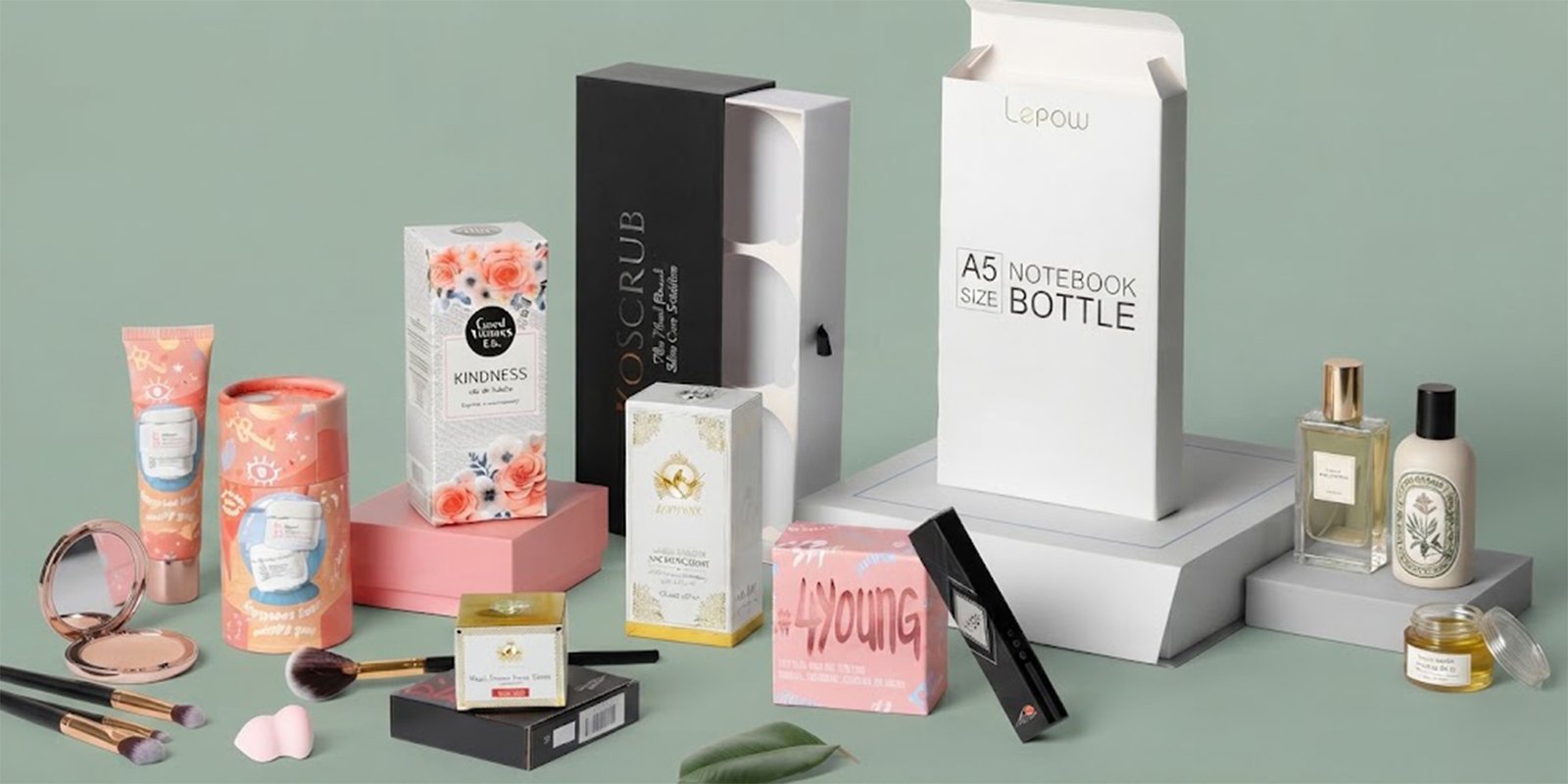
Folding Cartons vs. Rigid Boxes: 2026 Price Comparison
A folding carton costs less than a rigid box at every volume level – typically 40 to 70% less per unit – because it uses lighter board, ships flat before assembly, and runs through largely automated production, where a rigid box relies more on hand-finishing.
| Format | Spec | 250 units | 1,000 units | 5,000 units |
| Folding carton | 350gsm FBB, CMYK, matt lamination | £1.20–£1.60 | £0.75–£1.05 | £0.45–£0.65 |
| Folding carton, premium finish | 400gsm FBB, spot UV or foil | £1.80–£2.40 | £1.20–£1.60 | £0.80–£1.10 |
| Rigid box | 1.5mm greyboard, printed wrap, gloss lamination | £2.80–£3.60 | £1.90–£2.50 | £1.30–£1.80 |
| Rigid box, soft-touch + magnetic closure | 2mm greyboard, soft-touch wrap | £4.00–£4.80 | £2.90–£3.50 | £2.10–£2.60 |
Why do rigid boxes cost so much more than folding cartons? Rigid boxes are built by wrapping printed paper around a thick greyboard core – a construction method that relies on more hand-finishing than a folding carton, which is die-cut, printed and formed largely by automated machinery. The greyboard core itself (1.5-2mm, versus a folding carton’s single sheet of 300-400gsm board) also costs more per square metre. Combined, that’s typically a 40-70% price gap at the same volume.
Rigid boxes still earn their place despite the cost. They earn it back through perceived value rather than raw protection – a heavier box changes how a product feels in hand before a customer has read a word of copy, which is why skincare and fragrance brands lean on rigid formats for hero products even when a folding carton would do the job structurally.
Does Plastic Packaging Tax Apply to Your Cosmetic Packaging?
Does Plastic Packaging Tax apply to cosmetic packaging components? Yes, if the component is plastic and contains under 30% recycled content. For cosmetics specifically, that typically means pumps, airless dispensers, PET jars and plastic caps – even when they’re paired with a paperboard carton that itself is exempt.
From 1 April 2026, the rate rises to £228.82 per tonne, up from £223.69, in line with the government’s annual CPI-linked increase. Any business manufacturing or importing 10 tonnes or more of finished plastic packaging components in a rolling 12-month period must register – regardless of whether tax ends up being owed, since packaging above the 30% recycled threshold still counts toward that 10-tonne test.
Source: Rödl & Partner’s PPT 2026 rate guide and Segura’s PPT business guidance.
For a cosmetics brand running a plastic pump dispenser as part of a bundled format, this tax rarely shows up as its own line on a supplier quote – it’s folded into the unit price, which is exactly why it’s worth asking about directly before signing off on a spec.
How can a cosmetic brand reduce Plastic Packaging Tax exposure? Switching to 30%+ recycled plastic content removes the liability on that component entirely. For brands weighing plastic against paperboard components, this is often the deciding factor once the tax is added to total cost rather than compared on unit price alone – and it’s worth checking again from April 2027, when a rule change means pre-consumer manufacturing offcuts will no longer count toward the 30% threshold, only genuine post-consumer recycled content. Source: BrightSustainability’s 2026 PPT SME guide.
EPR Fees by Material: What They Add to Your Unit Cost
What is EPR and why does it affect cosmetic packaging cost? Extended Producer Responsibility (EPR) charges businesses a disposal fee, based on packaging material and weight, to fund the actual cost of collecting and recycling that packaging once it reaches a customer. The fee varies enormously by material and – from the 2026-27 scheme year – by how recyclable a specific format is rated, which makes material and construction choice a cost decision as much as a design one.
PackUK published confirmed Year 1 (2025-26) base fees and illustrative Year 2 (2026-27) fees in December 2025. Year 2 introduces modulation: an “amber” base rate for each material, with Red-rated (hard-to-recycle) packaging paying roughly 20% more than amber, and Green-rated (easily recyclable) packaging paying roughly 9% less.
| Material | Year 1 (2025-26) base | Year 2 (2026-27) illustrative amber | Year 2 Green | Year 2 Red |
| Glass | £192/tonne | £205/tonne | ~£186/tonne | ~£246/tonne |
| Aluminium | £266/tonne | £270/tonne | ~£245/tonne | ~£324/tonne |
| Plastic | £423/tonne | £455/tonne | £415/tonne | £545/tonne |
| Fibre-based composite | £461/tonne | £525/tonne | ~£475/tonne | ~£630/tonne |
Source: PackUK’s Year 2 illustrative fees as reported by edie.net, Labelservice’s Year 2 fee breakdown, and RECOUP’s summary of DEFRA’s illustrative base fees. Year 2 figures are illustrative pending confirmation, expected June 2026.
A Worked Example: What EPR Actually Adds to an Order
A brand ordering 5,000 rigid boxes at roughly 45g of plastic-laminated wrap per unit is carrying about 0.225 tonnes of plastic-rated packaging in that run (5,000 × 45g = 225kg). At the Year 1 confirmed rate of £423/tonne, that’s roughly £95 in EPR liability on the order – before the unit price of the box itself is added. Under Year 2’s illustrative Red rate of £545/tonne, the same run would carry closer to £123. Swap the plastic laminate for an aqueous coating that rates Green instead of Red, and the same 0.225 tonnes drops to roughly £93 at the Year 2 Green rate – a real, calculable difference driven entirely by a coating choice, not the box’s structure.
Can changing packaging material actually lower EPR fees, or is the saving mostly theoretical? It’s calculable, not theoretical. On a 5,000-unit run carrying roughly 0.225 tonnes of plastic-rated material, moving from a Red-rated laminate to a Green-rated aqueous coating shifts the EPR liability from around £123 to around £93 under Year 2’s illustrative rates – a difference driven purely by recyclability rating, with no change to the box’s structure or print.
What’s Changing From 2026-27
Fees are moving from flat base rates to the modulated Red/Amber/Green structure shown above. For anyone specifying cosmetic packaging now, this is worth building into decisions today rather than treating it as a future problem – specs chosen this year will still be in production once modulated invoicing lands in the second half of 2026.
Setup and Tooling Costs You Should Budget For
These are one-off charges, paid once regardless of how many times you reorder the same spec:
- Cutting dies: £100–£1,200, depending on box complexity and shape
- Foiling or embossing dies: £150–£1,500
- Physical samples: £25–£600 before committing to a full run
- Colour matching and plate setup: varies by print method, typically higher for litho than digital
Smaller order volumes feel these costs more heavily, since there’s less production run to spread them across – which is often the real reason a small first order looks expensive per unit even when the box itself is a simple format.
How Much Does Order Volume Actually Change the Price?
A skincare brand ordering 300 units of a folding carton for a first product run was quoted £1.55 per unit. Increasing the order to 1,200 units for their second run brought the price down to £0.85 per unit – the setup cost stayed fixed, but it was now spread across four times the packaging, not because the box itself changed at all.
That pattern holds broadly: unit price tends to drop 20–40% moving from a few hundred units to a few thousand, then the rate of saving slows. Ordering 20,000 units instead of 10,000 rarely halves the price again – the steepest savings happen in the first jump past your MOQ, not in scaling further beyond it.
Folding Carton or Rigid Box: Which Actually Costs Less?
Once EPR and Plastic Packaging Tax are factored in alongside unit price, folding cartons stay the cheaper option by an even wider margin than the sticker price suggests. Paperboard formats without plastic lamination sit in the lower EPR fee band and typically avoid Plastic Packaging Tax altogether, while a laminated rigid box can be carrying both costs on top of its already higher unit price.
That doesn’t make rigid boxes the wrong choice for a £40+ product where the unboxing moment drives repeat purchase – the cost difference is often worth paying deliberately. It does mean the decision is no longer just print quote versus print quote. It’s total landed cost versus total landed cost, and that’s a comparison most suppliers won’t run for you unless you ask.
The Bottom Line
The number on a supplier’s quote rarely tells the whole story. Board grade, finish and volume decide the price you see, but format choice now carries a second, quieter cost – tied to how a material is classified under EPR and whether it falls inside Plastic Packaging Tax at all. A brand comparing two boxes purely on unit price can end up choosing the more expensive option without realising it, simply because nobody added the regulatory side of the bill. Treating unit price and regulatory cost as one combined figure, rather than two separate conversations, is what actually protects margin in 2026.
A reliable quote needs your exact dimensions, target board grade, print coverage and finish, and order volume – anything less produces a range too wide to plan a budget around. At Hale Path Packaging, quotes factor in material, finish and current UK regulatory costs together, so the number you see reflects what you’ll actually pay, not just what the box costs to print.
Get a spec-based quote from Hale Path Packaging, or explore our custom cosmetic packaging range to see formats and finishes available for UK production.
Related: Custom Cosmetic Packaging UK: EPR & Compliance Guide · Cosmetic Packaging Labelling Requirements UK · Packaging EPR UK for Small Businesses · Custom Eyeshadow Boxes · Custom Lipstick Boxes

Harry Taylor
Packaging expert at Hale Path Packaging, sharing insights on custom packaging solutions, sustainable materials, and industry trends.